Vitorr Classes | Science & Discovery. A newly reported particle-physics result at CERN provides an unusually precise test of the laws governing matter. This original explainer separates what researchers measured from what remains hypothetical.
The discovery that took four decades
Imagine searching for an event so rare that ten billion unstable particles might need to be produced before one follows the pathway you are looking for. That is the scale of the challenge facing physicists studying neutral beauty mesons. On 3 November 2026, the University of Birmingham reported that the LHCb collaboration at CERN had obtained evidence for the exceptionally rare decay of a neutral B meson into a pair of muons. The announcement described a milestone in a 42-year scientific pursuit. Evidence is the important word: the team has not announced a new fundamental force, nor has it shown that the Standard Model is wrong. Instead, it has strengthened a demanding experimental test of the existing theory.
What exactly did scientists observe?
The process begins with an unstable neutral meson containing a beauty quark or its antiquark. Under extremely unusual circumstances, it transforms into two muons, one positively charged and one negatively charged. Muons resemble electrons but are much heavier. The decay is difficult to detect because ordinary collisions produce numerous other particles, and many processes can imitate parts of its signature. Researchers must reconstruct tracks, identify particle species, and statistically distinguish a tiny signal from a huge background. The Birmingham announcement says the predicted frequency for this particular neutral B-meson decay is approximately one occurrence per ten billion particles. This is a predicted branching fraction, not a claim that precisely ten billion particles were observed in a single run.
The invisible world inside ordinary matter
Everything from a grain of sand to a human body is built from atoms. Atoms contain electrons surrounding nuclei made of protons and neutrons. Protons and neutrons are themselves built from quarks. The six known quark flavours are up, down, charm, strange, top and bottom, the last also called beauty. Quarks do not normally appear as isolated free particles; they combine into composite particles called hadrons. Mesons are hadrons consisting of a quark and an antiquark. A neutral B meson is one such short-lived composite. Studying how it transforms helps researchers understand the fundamental interactions operating far beneath the scale of atoms.
Why beauty particles are special
Beauty particles contain a comparatively heavy quark. They are produced in high-energy collisions and survive for only around one and a half trillionths of a second before decaying. That is far too brief for a conventional camera, but modern particle detectors can infer their existence from the paths and properties of the particles they leave behind. The physics of beauty-quark decays is especially useful because different theoretical contributions can influence the probability of rare outcomes. If an unknown particle or interaction exists, its effects might appear indirectly as a small deviation from a precisely calculated rate.
Understanding the Standard Model
The Standard Model is the mathematical framework describing known elementary particles and three of the four fundamental interactions: electromagnetic, strong and weak. Gravity is not included in the framework in the same way. The model has successfully predicted many experimental results, including the Higgs boson, yet it does not explain everything. The nature of dark matter, the observed matter-antimatter imbalance, and the unification of gravity with quantum physics remain open questions. Rare decays are therefore valuable: they allow scientists to test a successful theory in conditions where tiny departures might become measurable.
Why the decay is so unlikely
Most unstable particles have several possible decay pathways, but the probability of each pathway can differ dramatically. Some are permitted through relatively direct interactions; others are suppressed by symmetries and quantum-mechanical effects. The decay discussed here is strongly suppressed in the Standard Model, which makes its expected branching fraction extraordinarily small. This is a feature, not a weakness, for experimental physics. A rare channel can be a clean place to look for subtle contributions from physics that current theories do not contain. However, a rare result is not automatically an anomalous one.
Inside CERN and the Large Hadron Collider
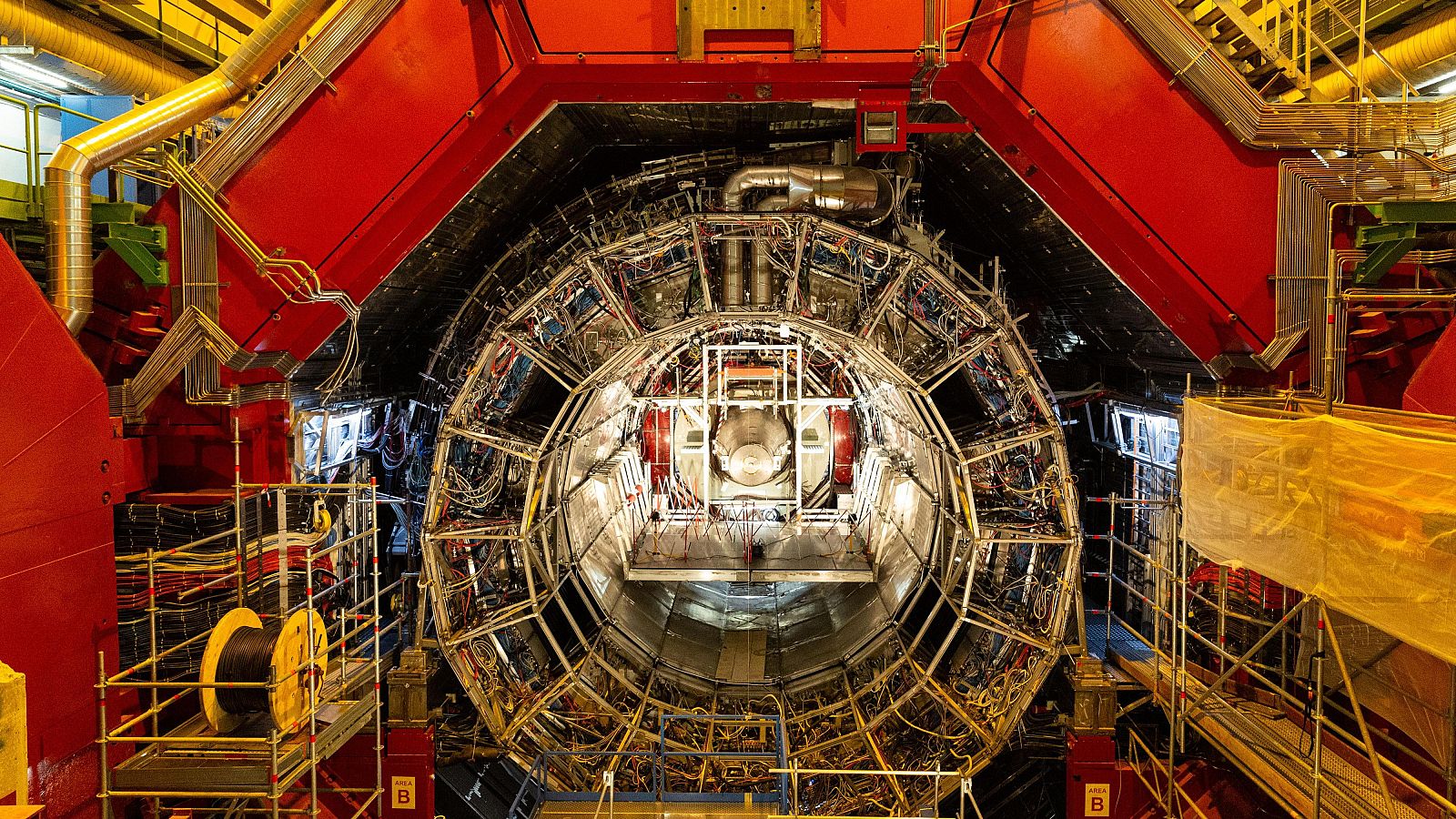
CERN is the European laboratory for particle physics near Geneva, on the France-Switzerland border. Its Large Hadron Collider accelerates beams of protons to enormous energies and brings them into collision. The collision energy can produce many short-lived particles, including hadrons containing beauty quarks. Several major experiments surround collision points. LHCb is specially designed to study beauty and charm particles, precision measurements and differences between matter and antimatter. The detector uses tracking systems, particle-identification devices and sophisticated electronics to reconstruct what happened in a collision long after the unstable particles have disappeared.
How researchers separated a rare signal from billions of events
The latest analysis combined data collected in 2024 and 2025 with earlier measurements from 2011 through 2018. Researchers used particle-identification techniques, careful detector calibration and advanced machine-learning methods to distinguish candidate decays from much more common backgrounds. A machine-learning classifier can help rank events according to how closely they resemble the expected signal, but the final physics conclusion still depends on statistical analysis, systematic uncertainties and independent scrutiny. The upgraded LHCb detector has collected data since 2024 at up to five times its earlier rate, improving the prospects for rare-event measurements.
What counts as evidence in particle physics?
Scientists distinguish an interesting excess from convincing evidence and from a formal discovery. Statistical significance measures how difficult an observed signal would be to explain as a fluctuation of background alone under a specified model. Particle physics often uses a five-sigma threshold for a discovery claim, although the complete evaluation also requires robust methods and control of systematic errors. The university announcement uses the term first evidence from a single experiment for the neutral B-meson decay. It should not be rewritten as definitive discovery of a new particle. The researchers also reported exceptionally precise measurements for the related Bs-meson decay probability and lifetime.
What is the Zeptoverse?
A zeptometre is 10 to the power of minus 21 metres. Scientists sometimes use the expression Zeptoverse as a vivid shorthand for extraordinarily short distances that may be indirectly probed through high-precision particle measurements. It is not a separate universe that researchers have photographed. In quantum physics, heavy hypothetical particles can influence measurable processes through virtual effects, even when those particles cannot be produced directly by a machine. Rare decay measurements therefore complement searches for new particles in collider collisions.
Does this overturn Einstein or prove a fifth force?
No. The newly reported results agree with Standard Model predictions within the measurement precision described by the researchers. That agreement is scientifically valuable because it narrows the space in which alternative theories can operate. It does not prove that all possible new physics has been ruled out. Equally, it does not demonstrate extra dimensions, faster-than-light travel, a fifth force or practical access to another universe. Headlines claiming any of these conclusions would go beyond the evidence. Future measurements with larger datasets could reveal a deviation, or they could further confirm the existing theory.
Why basic science matters to society
Particle physics rarely delivers a consumer product immediately after a discovery. Its practical value often emerges through decades of instrumentation, computing and technical collaboration. Particle accelerators, precision detectors, superconducting systems and high-throughput data analysis have contributed knowledge and techniques used in medicine, imaging, manufacturing and computing. The connection is indirect: this particular rare decay is not itself a new cancer treatment or commercial device. The broader research ecosystem trains scientists and engineers to solve demanding measurement problems that may later find applications elsewhere.
The role of artificial intelligence in discovery
The LHCb analysis illustrates a less sensational but important role for AI: helping researchers identify patterns in large datasets. When detectors record enormous numbers of particle interactions, computational tools help select promising candidates and suppress backgrounds. These methods are not substitutes for physical theory or reproducible statistical tests. Scientists must check whether training samples are representative, whether detector conditions bias classifications, and whether uncertainties have been accounted for. The strongest research combines computational speed with transparent scientific reasoning.
What the result means for India
Indian students interested in this field can build foundations in mathematics, classical mechanics, electromagnetism, quantum mechanics, statistics and programming. Research opportunities span universities, national laboratories, detector development, scientific computing and international collaborations. Large-scale science also depends on engineers who design electronics, cooling systems, sensors, high-speed networks and reliable software. A physics degree is one route, but electronics, computer science, instrumentation and data science also contribute to modern experiments. Readers should consult current institutional admissions and collaboration information rather than assuming a specific programme is available.
The next chapter for LHCb
As LHCb continues collecting data with upgraded instrumentation, researchers can improve the precision of branching-fraction and lifetime measurements. Comparing related decay channels may reveal patterns that a single result cannot establish. Independent experiments and future theoretical calculations will be important in testing any apparent discrepancy. The most exciting outcome may be a surprise, but a more precise confirmation of the Standard Model would also be a major scientific achievement. The purpose of careful measurement is to learn what nature does, not to force an extraordinary headline.
Conclusion: the power of asking difficult questions
A particle that survives for barely a trillionth of a second can help researchers examine some of the deepest rules of the universe. The latest LHCb evidence illustrates the patience required for fundamental science: decades of theory, upgraded detectors, international teamwork and painstaking analysis of rare events. The result has not rewritten physics overnight. It has opened a more precise window through which scientists can test whether the laws we know are the complete story. For readers, that is the real significance of the breakthrough.
Frequently asked questions
Did CERN discover a new fundamental particle?
No. The reported result concerns evidence for an extremely rare decay of an already studied class of particles, not the discovery of a new elementary particle.
How rare is the decay?
The Standard Model predicts roughly one such neutral B-meson decay into two muons for every ten billion of those particles.
What are muons?
Muons are elementary charged leptons similar to electrons but considerably heavier.
Why use machine learning?
Machine-learning tools help classify candidate events and reduce background noise in enormous particle-collision datasets.
What does the result say about the Standard Model?
The reported measurements agree with its predictions while providing a more sensitive test.
Can this discovery immediately change daily technology?
No immediate consumer application follows from the decay itself, although detector and computing research can have wider benefits.
Sources and further reading
Primary institutional reporting: University of Birmingham, 3 November 2026. Readers can follow the research paper linked from the university release. Scientific statements above distinguish the measured result from possible future implications.
Read the University of Birmingham research announcement
 History Geography General Science Economy