Vitorr Classes Science Feature | 29 October 2026. A remarkable frozen record in Tibet could reshape the history of mountain glaciers. Here is what the peer-reviewed evidence actually shows—and what it does not.
A frozen archive older than human civilisation
A glacier high on the Tibetan Plateau has preserved something extraordinary: ice that may record environmental conditions from roughly 128,000 years ago. This is not an ice block newly formed in 2026. It is an ancient archive whose age has been reassessed through a scientific study published in Science Advances on 30 September 2026 and highlighted again in international science coverage on 29 October. The distinction matters: an older discovery reaching a wider audience today should not be presented as if the original research were published today. The ice comes from the Guliya Ice Cap in northwestern Tibet, where extreme altitude and geography have helped protect unusually old frozen layers.
What is an ice core?
An ice core is a long cylinder drilled through a glacier or ice sheet. Snow falls, accumulates and is compressed into ice over many years. Each layer can retain traces of the environment at the time of formation, including variations in oxygen isotopes, dust and chemical compounds. Scientists interpret these signals alongside independent dating evidence. An ice core is not a perfect thermometer, and the relationship between its chemical composition and local temperature can change. Researchers must therefore test interpretations carefully rather than reading every layer as a direct temperature measurement.
Why Guliya is special
The Guliya Plateau sits in a high, cold region of the Tibetan Plateau. Most mountain glaciers outside Antarctica and Greenland preserve records covering much shorter periods because ice melts, flows or becomes disturbed. The Guliya study presents evidence that some ice is older than 100,000 years and that its reconstructed timeline may reach 128,000 years. This makes the site particularly valuable for comparing climate records across regions. It does not mean every metre of the glacier is 128,000 years old, nor that all parts have remained completely unchanged.
Two drilling expeditions, 23 years apart
The researchers compared cores collected in 1992 and 2015. One was about 309 metres long and the other about 310 metres. Despite the interval between drilling expeditions, their oxygen-isotope patterns were similar. Such agreement is important because an individual ice-core record can be distorted by local conditions or measurement uncertainty. When independently collected samples show related signals, scientists gain confidence that they are observing a real environmental history rather than a laboratory artefact.
How researchers estimated the age
The team used the radioactive isotopes beryllium-10 and chlorine-36, together with other climate records, to build a chronology. Their measurements helped identify evidence associated with the Laschamp geomagnetic excursion, an unusual episode in Earth’s magnetic-field history about 41,000 years ago. They then compared Guliya oxygen-isotope variations with records from Asian monsoon cave deposits. These independent anchors support a timeline extending toward 128,000 years. This is a reconstruction supported by multiple kinds of evidence, not a claim that scientists counted 128,000 separate annual layers.
What oxygen isotopes reveal
Oxygen occurs in several stable isotopic forms. The ratio of oxygen-18 to oxygen-16 in precipitation depends on processes such as evaporation, atmospheric circulation and condensation. As snow becomes ice, that isotopic composition is preserved. Changes along a core can help reconstruct earlier environmental conditions, but the signals are influenced by moisture sources and seasonal precipitation as well as temperature. Comparing ice with cave deposits, polar records and other archives helps scientists avoid oversimplified conclusions.
A window into the last glacial cycle
The estimated Guliya timeline reaches back toward the last interglacial period and spans much of the last glacial cycle. Researchers can use it to ask when mountain ice accumulated, how it survived warmer intervals and how high-altitude conditions tracked wider climate patterns. The new chronology also suggests that ice from the last glacial period persisted into the Holocene, which began about 11,700 years ago. That conclusion changes how scientists understand the survival of mountain ice in this part of Asia.
Why the Himalayas and India should pay attention
The Tibetan Plateau and the Himalayan region influence major Asian river systems and support communities dependent on snow, glaciers and seasonal water flows. The Guliya core is not a forecast of next year’s monsoon or a direct measurement of current river discharge. Its value lies in the longer perspective it gives scientists: how mountain ice responded to climate changes over tens of thousands of years. This context can improve scientific questions about glacier stability, but present-day water planning still requires modern observations, local hydrology and realistic emissions scenarios.
Does ancient ice mean climate change is not happening?
No. Evidence that some ice survived previous warm periods does not contradict modern measurements of warming or glacier retreat. Ice survival depends on altitude, terrain, snowfall, ice flow and local climate. A protected high-elevation core can persist while other glaciers lose mass. The correct comparison is between distinct locations, timescales and measurements. Ancient ice helps researchers understand natural climate variability and the unusual pace of present-day changes; it cannot by itself settle every question about current climate trends.
What the study does not prove
The findings do not establish the exact age of every ice layer, predict a particular flood, or demonstrate that the entire Tibetan Plateau was continuously covered by ice for 128,000 years. Some relationships between Guliya isotope records and climate drivers appear to change after deglaciation, and the researchers explicitly identify questions for future work. Scientific strength comes from describing uncertainty as well as results. The central claim is that several independent measurements support a much longer Guliya ice chronology than previously accepted.
The technology behind the discovery
This research combines demanding fieldwork with laboratory analysis and cross-checking against records from other environments. Ice cores are drilled in remote, high-altitude conditions and must be preserved during transport and storage. Laboratory teams then measure isotope ratios, radioactive tracers and other signals. Dating methods gain credibility when their results agree with known geological events and independent archives. The project illustrates how advances in analytical science can transform the interpretation of samples collected decades earlier.
What scientists may investigate next
With a revised timeline, scientists can re-examine chemical and environmental indicators already preserved in the cores. They may investigate changes in atmospheric circulation, dust transport, precipitation and glacial survival across earlier climate transitions. Researchers will also need to clarify why some isotope relationships appear different after the last ice age. More data and comparisons with other regional archives will determine which interpretations remain robust. The most exciting outcome may be a better framework for questions that could not previously be dated reliably.
The bigger lesson
The discovery reminds us that scientific progress often comes from revisiting old evidence with better tools. Ice drilled in 1992 can become newly informative when compared with a 2015 core and modern dating methods. For students, the lesson extends beyond geography: reliable knowledge grows through replication, independent checks and a willingness to revise earlier assumptions. The Guliya Ice Cap is a rare archive of Earth’s history—and a reminder that protecting scientific records matters before they disappear.
Frequently asked questions
Has a 128,000-year-old glacier just been discovered?
No. The ice cores were collected in 1992 and 2015. A 2026 study provided stronger evidence for their ancient age.
Where is the Guliya Ice Cap?
It is on the Tibetan Plateau in northwestern Tibet.
How did scientists date the ice?
They combined beryllium-10 and chlorine-36 measurements with the Laschamp magnetic event and comparisons to cave oxygen-isotope records.
Does the study predict earthquakes or monsoon rainfall?
No. It reconstructs ancient climate history; it does not provide short-term hazard forecasts.
Why is this important for climate science?
It offers an unusually long mountain-glacier archive outside the polar regions and helps researchers investigate ice survival through past climate transitions.
Read the original research and reporting
These references provide the research paper, institutional explanation and accessible reporting. Readers should consult the primary paper for methodological detail.
Read the peer-reviewed research ↗
Read Ohio State University’s explanation ↗
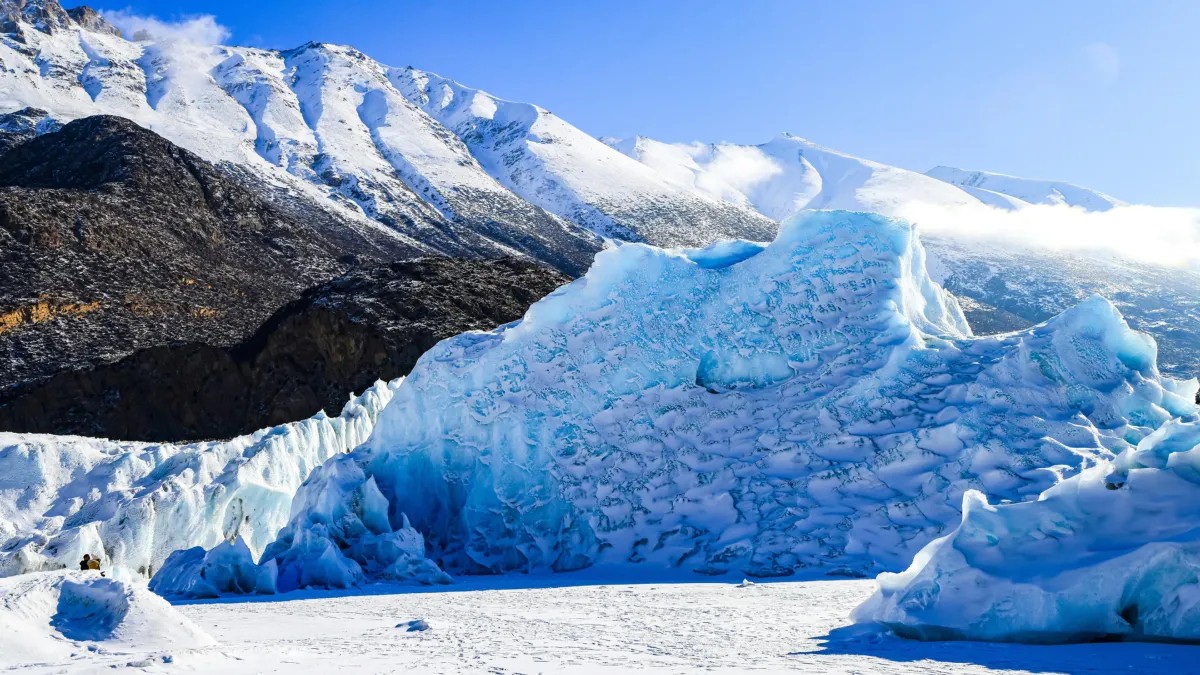
Editorial transparency: The research was published in September 2026 and received renewed coverage on 29 October. The image is illustrative, not a photograph of the exact Guliya drilling site.
 History Geography General Science Economy