What Happened
1. Why in News?
On 19 October 2026, the Press Information Bureau published a backgrounder titled Pumped Storage Hydropower: Powering India's Clean Energy Transition. It highlighted India's operational pumped storage capacity, identified project potential, development pipeline and projected expansion through 2035–36. The backgrounder explains how pumped storage can support the integration of renewable electricity into India's power grid.
2. What Is Pumped Storage Hydropower?
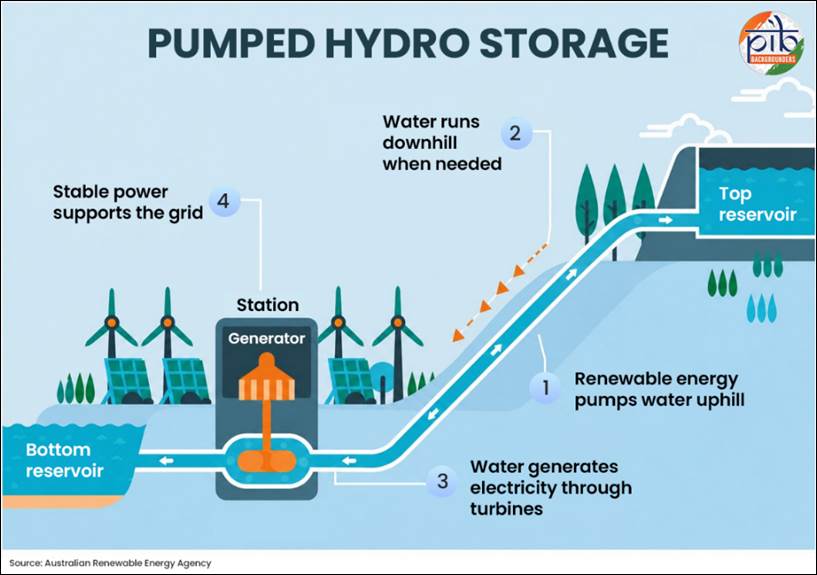
Pumped Storage Hydropower is an electricity storage technology that uses water and differences in elevation to store and release energy. It generally consists of two reservoirs at different heights, connected through tunnels or pipelines and equipped with pumping and electricity-generating machinery.
3. Why Is It Called a Water Battery?
Pumped storage is sometimes described as a water battery because it stores energy when electricity is available and releases electricity when required. Instead of storing electrical energy through chemical reactions, it stores energy as the gravitational potential energy of water at a higher elevation.
4. How Does the System Store Energy?
During periods of low electricity demand or surplus renewable generation, electricity powers pumps that move water from a lower reservoir to an upper reservoir. The elevated water stores gravitational potential energy until electricity is needed.
5. How Does It Generate Electricity?
When electricity demand increases, water flows from the upper reservoir to the lower reservoir through turbines. The moving water rotates the turbines, which drive generators to produce electricity. The water can subsequently be pumped back uphill for another operating cycle.
6. Why Is Pumped Storage Important for Solar and Wind Power?
Solar and wind electricity generation varies with sunlight and wind conditions. Pumped storage helps manage this variability by absorbing surplus electricity and delivering power during periods when renewable generation is insufficient or electricity demand is high.
7. Operational Capacity in India
According to the official backgrounder, India had approximately 7.43 gigawatts of operational pumped storage capacity across 10 projects as of August 2026. The reported operational projects have installed capacities exceeding 25 megawatts.
8. Projects Under Construction
A further 15.87 gigawatts of capacity across 11 pumped storage projects was under construction or implementation. This capacity should not be included in the already operational figure because construction and operation represent different project stages.
9. Projects Appraised by CEA
Another 10.40 gigawatts across eight projects had been concurred or appraised by the Central Electricity Authority. These projects form part of the development pipeline but should not be described as already generating electricity.
10. Total Identified Potential
India has identified 320 pumped storage projects with a combined potential of 345.38 gigawatts. This figure represents identified potential across different development stages, not currently installed or operational capacity.
11. On-Stream Pumped Storage
In an on-stream pumped storage scheme, both reservoirs are located on a river, stream or natural watercourse. Water is released through turbines to generate electricity and pumped back to the upper reservoir when electricity is available for storage.
12. On-Stream Potential
The official assessment identifies 62 on-stream pumped storage projects with a combined potential of 56.67 gigawatts. Their suitability depends on geographical, engineering and environmental conditions.
13. Off-Stream Open-Loop Pumped Storage
An off-stream open-loop scheme has one reservoir on a river or perennial watercourse, while the other reservoir is located away from such a natural watercourse. The reservoirs exchange water through the pumped storage operating cycle.
14. Off-Stream Closed-Loop Pumped Storage
In an off-stream closed-loop scheme, neither reservoir is located on a river or perennial natural watercourse. The system operates using two reservoirs situated away from perennial streams, with water moving between them during charging and electricity generation.
15. Off-Stream Potential
India has identified 258 off-stream pumped storage projects with a combined potential of 288.71 gigawatts. This is substantially larger than the identified on-stream potential.
16. Environmental Importance of Off-Stream Projects
The government is encouraging the identification of more off-stream projects located away from rivers. Such projects may help reduce certain impacts on aquatic ecology and surrounding environments, although each project still requires appropriate environmental and technical assessment.
17. Western Region Potential
The Western Region has the highest identified pumped storage potential at 129.72 gigawatts. The Central Electricity Authority links this potential partly to favourable topography and steep gradients associated with rivers originating in the Western Ghats.
18. Maharashtra's Potential
Maharashtra accounts for approximately 67.36 gigawatts of identified pumped storage potential. It is an important state for examinations concerning the geographical distribution of India's energy resources.
19. Gujarat's Potential
Gujarat has approximately 33.36 gigawatts of identified pumped storage potential. Together, Maharashtra and Gujarat make the Western Region especially significant for future pumped storage development.
20. Southern Region Potential
The Southern Region has approximately 97.76 gigawatts of identified pumped storage potential. Andhra Pradesh, Telangana and Tamil Nadu are important states within this regional resource base.
21. Eastern Region Potential
The Eastern Region has approximately 53.41 gigawatts of identified potential. Odisha alone accounts for approximately 41.53 gigawatts, making it an important state in the regional assessment.
22. Northern Region Potential
The Northern Region has approximately 50.32 gigawatts of identified pumped storage potential. Uttar Pradesh and Himachal Pradesh are among the important states associated with this region.
23. North Eastern Region Potential
The North Eastern Region contributes approximately 14.18 gigawatts to India's identified pumped storage potential. The national assessment therefore includes resources distributed across all five regions.
24. Capacity Roadmap Through 2035–36
The Central Electricity Authority has prepared a pathway envisaging approximately 100.81 gigawatts of additional pumped storage capacity through 2035–36. This would take cumulative installed capacity to approximately 105.56 gigawatts if the projected additions are achieved.
25. Important Capacity Distinction
The 100.81 gigawatt figure refers to projected capacity additions in the roadmap, while 105.56 gigawatts represents the projected cumulative capacity by 2035–36. The 345.38 gigawatt figure represents identified potential and must not be confused with either projection.
26. Projection for 2030–31
The roadmap envisages cumulative pumped storage capacity reaching approximately 52.99 gigawatts by 2030–31. This is a projection and not the operational capacity recorded in October 2026.
27. Projection for 2032–33
The roadmap envisages approximately 76.38 gigawatts of cumulative pumped storage capacity by 2032–33. Achieving this would require successful project development, financing, approvals and construction.
28. India's Global Position
According to the official backgrounder, India ranked fourth globally in installed pumped storage capacity at the end of 2025, with approximately 7.18 gigawatts. The ranking and capacity figure refer to that reporting period, not to every subsequent date.
29. Global Pumped Storage Capacity
The International Renewable Energy Agency reported approximately 159.8 gigawatts of global installed pumped storage capacity at the end of 2025. Pumped hydropower is among the most established forms of large-scale electricity storage.
30. Leading Countries
At the end of 2025, China accounted for nearly 66 gigawatts of installed pumped storage capacity, followed by Japan with around 22 gigawatts and the United States with around 19 gigawatts. India ranked fourth according to the PIB backgrounder.
31. India's Non-Fossil Electricity Capacity
India crossed 300 gigawatts of installed non-fossil fuel-based electricity generation capacity by July 2026. During financial year 2025–26, approximately 55.29 gigawatts of non-fossil capacity was added, according to the official backgrounder.
32. India's 2030 Energy Target
India has set a target of achieving 500 gigawatts of non-fossil fuel-based electricity capacity by 2030. Energy storage technologies, including pumped storage, are important for managing the variable generation associated with renewable electricity.
33. Government Guidelines of 2023
The Ministry of Power notified the Guidelines to Promote Development of Pumped Storage Projects in India in April 2023. These guidelines form part of the policy framework supporting development of pumped storage projects.
34. Faster Project Appraisal
The official backgrounder states that the relevant project appraisal timeline has been reduced from 90 days to 50 days. Streamlined processes can help shorten development timelines, subject to compliance with applicable requirements.
35. Environmental Appraisal Reforms
The Ministry of Environment, Forest and Climate Change has introduced differentiated environmental appraisal provisions for pumped storage projects. Eligible projects may benefit from B2 categorisation and certain off-stream projects may have reduced baseline data requirements, subject to applicable rules.
36. CEA Concurrence Threshold
A Government of India notification dated 1 August 2025 revised the capital expenditure threshold for hydroelectric schemes requiring concurrence from the Central Electricity Authority to ₹3,000 crore. The official backgrounder also notes an exemption for off-stream closed-loop pumped storage schemes from this concurrence requirement, irrespective of capital expenditure.
37. Jal Vidyut DPR Portal
The Central Electricity Authority's Jal Vidyut DPR portal supports monitoring of survey and investigation activities and coordination during project preparation. Digital monitoring can help identify delays and improve administrative oversight.
38. Grid Flexibility
Grid flexibility is the ability of the electricity system to respond to changes in supply and demand. Pumped storage can support flexibility by shifting electricity availability across different periods and helping maintain system reliability.
39. Peak Demand Management
Electricity demand often increases during particular hours. Pumped storage can release stored electricity during peak-demand periods, reducing the mismatch between generation and consumption.
40. Difference Between Power and Energy
Gigawatts measure power capacity, while gigawatt-hours measure energy. A pumped storage project's power rating does not by itself reveal how many hours it can operate at that output. Reservoir volume, operating head and other technical factors influence storage duration.
41. Energy Efficiency Considerations
Pumped storage consumes electricity when pumping water uphill and generates electricity when water flows downhill. Some energy is lost during pumping, generation and water movement. Its value lies in storing and shifting electricity and providing grid services, not creating additional energy without an input.
42. Technical Factors in Project Selection
Project assessment considers topography, geology, hydrology, reservoir characteristics, foundation conditions, seismicity, construction materials, transmission connectivity and environmental factors. A site with high theoretical potential is not necessarily suitable for immediate development.
43. Economic Significance
Pumped storage development may create demand for engineering, construction, electrical equipment, turbines, pumps, transmission infrastructure and specialised technical services. Actual economic benefits depend on project viability, financing and execution.
44. Environmental and Social Challenges
Projects may require substantial construction, land, water infrastructure and transmission connections. Their environmental and social effects vary by location and design. Appropriate appraisal and mitigation remain important even where a project supports clean energy integration.
45. Overall Significance
India's pumped storage programme is a major component of long-duration electricity storage planning. The identified 345.38 gigawatt potential, operational 7.43 gigawatt capacity and projected expansion to 105.56 gigawatts by 2035–36 demonstrate both the scale of the opportunity and the substantial work needed to develop it.
क्या हुआ?
1. चर्चा में क्यों?
19 अक्टूबर 2026 को प्रेस सूचना ब्यूरो ने भारत के स्वच्छ ऊर्जा परिवर्तन में पंप भंडारण जलविद्युत की भूमिका पर एक विस्तृत पृष्ठभूमि लेख प्रकाशित किया। इसमें देश की परिचालन क्षमता, पहचानी गई परियोजनाओं की संभावित क्षमता, निर्माणाधीन परियोजनाओं और वित्त वर्ष 2035–36 तक के विस्तार की रूपरेखा प्रस्तुत की गई। यह तकनीक अक्षय ऊर्जा को विद्युत ग्रिड में प्रभावी ढंग से शामिल करने में सहायता कर सकती है।
2. पंप भंडारण जलविद्युत क्या है?
पंप भंडारण जलविद्युत बिजली को संग्रहित करने की ऐसी तकनीक है जिसमें जल और ऊंचाई के अंतर का उपयोग किया जाता है। सामान्यतः इसमें अलग-अलग ऊंचाइयों पर स्थित दो जलाशय, उन्हें जोड़ने वाली सुरंगें या पाइपलाइन तथा जल पंप करने और बिजली बनाने वाली मशीनें होती हैं।
3. इसे जल बैटरी क्यों कहा जाता है?
पंप भंडारण को कभी-कभी जल बैटरी कहा जाता है क्योंकि यह उपलब्ध बिजली की सहायता से ऊर्जा संग्रहित करता है और आवश्यकता होने पर बिजली वापस उपलब्ध कराता है। इसमें रासायनिक प्रतिक्रियाओं के बजाय ऊंचाई पर स्थित जल की गुरुत्वीय स्थितिज ऊर्जा के रूप में ऊर्जा संग्रहित होती है।
4. ऊर्जा का भंडारण कैसे होता है?
जब बिजली की मांग कम होती है या अक्षय ऊर्जा का अतिरिक्त उत्पादन होता है, तब बिजली की सहायता से पंप निचले जलाशय का पानी ऊपरी जलाशय तक पहुंचाते हैं। ऊंचाई पर पहुंचा पानी गुरुत्वीय स्थितिज ऊर्जा के रूप में ऊर्जा संग्रहित करता है।
5. बिजली का उत्पादन कैसे होता है?
जब बिजली की मांग बढ़ती है, तब ऊपरी जलाशय का पानी टरबाइन से होकर निचले जलाशय की ओर बहता है। बहता पानी टरबाइन को घुमाता है और उससे जुड़े जनरेटर बिजली उत्पन्न करते हैं। बाद में पानी को फिर ऊपर पंप करके अगला चक्र शुरू किया जा सकता है।
6. सौर और पवन ऊर्जा के लिए महत्व
सौर और पवन ऊर्जा का उत्पादन धूप तथा हवा की उपलब्धता के अनुसार बदलता रहता है। पंप भंडारण अतिरिक्त बिजली को संग्रहित करके ऐसे समय बिजली उपलब्ध करा सकता है जब अक्षय ऊर्जा उत्पादन कम हो या मांग अधिक हो।
7. भारत की परिचालन क्षमता
आधिकारिक पृष्ठभूमि लेख के अनुसार अगस्त 2026 तक भारत में 10 परियोजनाओं के माध्यम से लगभग 7.43 गीगावाट पंप भंडारण क्षमता परिचालन में थी। रिपोर्ट में शामिल परिचालन परियोजनाओं की स्थापित क्षमता 25 मेगावाट से अधिक है।
8. निर्माणाधीन परियोजनाएं
देश में 11 परियोजनाओं के अंतर्गत अतिरिक्त 15.87 गीगावाट क्षमता निर्माण या कार्यान्वयन के चरण में थी। इस क्षमता को पहले से परिचालित क्षमता में नहीं जोड़ना चाहिए क्योंकि निर्माण और परिचालन परियोजना विकास के अलग-अलग चरण हैं।
9. केंद्रीय विद्युत प्राधिकरण द्वारा मूल्यांकित परियोजनाएं
आठ अन्य परियोजनाओं की कुल 10.40 गीगावाट क्षमता को केंद्रीय विद्युत प्राधिकरण की सहमति या मूल्यांकन प्राप्त हुआ था। ये परियोजनाएं विकास प्रक्रिया का हिस्सा हैं, लेकिन इन्हें पहले से बिजली उत्पन्न करने वाली परियोजनाएं नहीं कहना चाहिए।
10. कुल पहचानी गई संभावित क्षमता
भारत में 320 पंप भंडारण परियोजनाओं की पहचान की गई है, जिनकी संयुक्त संभावित क्षमता 345.38 गीगावाट है। यह आंकड़ा विकास के विभिन्न चरणों की संभावित क्षमता दर्शाता है, न कि वर्तमान स्थापित या परिचालन क्षमता।
11. नदी-आधारित पंप भंडारण
नदी-आधारित व्यवस्था में दोनों जलाशय नदी, धारा या प्राकृतिक जलमार्ग पर स्थित होते हैं। बिजली उत्पादन के लिए पानी टरबाइन से होकर नीचे बहता है और ऊर्जा उपलब्ध होने पर उसे वापस ऊपरी जलाशय में पंप किया जाता है।
12. नदी-आधारित संभावित क्षमता
आधिकारिक आकलन में 62 नदी-आधारित परियोजनाओं की पहचान की गई है, जिनकी संयुक्त संभावित क्षमता 56.67 गीगावाट है। इनकी उपयुक्तता भौगोलिक, अभियांत्रिक और पर्यावरणीय परिस्थितियों पर निर्भर करती है।
13. नदी से आंशिक रूप से जुड़ी बाह्य-धारा व्यवस्था
बाह्य-धारा खुली-परिपथ व्यवस्था में एक जलाशय नदी या बारहमासी प्राकृतिक जलमार्ग पर स्थित होता है, जबकि दूसरा ऐसे जलमार्ग से दूर होता है। पंप भंडारण के संचालन चक्र में दोनों जलाशयों के बीच पानी का आवागमन होता है।
14. बाह्य-धारा बंद-परिपथ व्यवस्था
बाह्य-धारा बंद-परिपथ व्यवस्था में कोई भी जलाशय नदी या बारहमासी प्राकृतिक जलमार्ग पर स्थित नहीं होता। दोनों जलाशय बारहमासी धाराओं से दूर होते हैं और ऊर्जा भंडारण तथा बिजली उत्पादन के दौरान पानी उनके बीच संचालित होता है।
15. बाह्य-धारा संभावित क्षमता
भारत में 258 बाह्य-धारा पंप भंडारण परियोजनाओं की पहचान हुई है, जिनकी संयुक्त संभावित क्षमता 288.71 गीगावाट है। यह नदी-आधारित पहचानी गई क्षमता से काफी अधिक है।
16. बाह्य-धारा परियोजनाओं का पर्यावरणीय महत्व
सरकार नदियों से दूर स्थित अधिक बाह्य-धारा परियोजनाओं की पहचान को प्रोत्साहित कर रही है। ऐसी परियोजनाएं जलीय पारिस्थितिकी और आसपास के पर्यावरण पर कुछ प्रभाव कम कर सकती हैं। हालांकि प्रत्येक परियोजना के लिए उचित पर्यावरणीय और तकनीकी मूल्यांकन आवश्यक रहता है।
17. पश्चिमी क्षेत्र की क्षमता
पश्चिमी क्षेत्र में सर्वाधिक 129.72 गीगावाट पहचानी गई पंप भंडारण क्षमता है। केंद्रीय विद्युत प्राधिकरण के अनुसार पश्चिमी घाट से निकलने वाली नदियों के तीव्र ढाल और अनुकूल स्थलाकृति इस क्षमता के महत्वपूर्ण कारण हैं।
18. महाराष्ट्र की क्षमता
महाराष्ट्र में लगभग 67.36 गीगावाट पहचानी गई संभावित क्षमता है। भारत के ऊर्जा संसाधनों के भौगोलिक वितरण से संबंधित परीक्षाओं में यह राज्य महत्वपूर्ण है।
19. गुजरात की क्षमता
गुजरात में लगभग 33.36 गीगावाट पहचानी गई संभावित क्षमता है। महाराष्ट्र और गुजरात मिलकर पश्चिमी क्षेत्र को भविष्य की पंप भंडारण परियोजनाओं के लिए महत्वपूर्ण बनाते हैं।
20. दक्षिणी क्षेत्र की क्षमता
दक्षिणी क्षेत्र में लगभग 97.76 गीगावाट पहचानी गई संभावित क्षमता है। आंध्र प्रदेश, तेलंगाना और तमिलनाडु इस क्षेत्र के महत्वपूर्ण राज्य हैं।
21. पूर्वी क्षेत्र की क्षमता
पूर्वी क्षेत्र में लगभग 53.41 गीगावाट पहचानी गई क्षमता है। अकेले ओडिशा में लगभग 41.53 गीगावाट क्षमता है, जिससे यह राज्य क्षेत्रीय आकलन में विशेष महत्व रखता है।
22. उत्तरी क्षेत्र की क्षमता
उत्तरी क्षेत्र में लगभग 50.32 गीगावाट पहचानी गई संभावित क्षमता है। उत्तर प्रदेश और हिमाचल प्रदेश इस क्षेत्र के महत्वपूर्ण राज्यों में शामिल हैं।
23. पूर्वोत्तर क्षेत्र की क्षमता
पूर्वोत्तर क्षेत्र भारत की कुल पहचानी गई पंप भंडारण क्षमता में लगभग 14.18 गीगावाट का योगदान देता है। राष्ट्रीय आकलन में सभी पांच क्षेत्रों के संसाधन शामिल हैं।
24. वित्त वर्ष 2035–36 तक की रूपरेखा
केंद्रीय विद्युत प्राधिकरण ने वित्त वर्ष 2035–36 तक लगभग 100.81 गीगावाट अतिरिक्त पंप भंडारण क्षमता विकसित करने की रूपरेखा तैयार की है। यदि अनुमानित विस्तार पूरा होता है, तो कुल स्थापित क्षमता लगभग 105.56 गीगावाट तक पहुंच सकती है।
25. क्षमता संबंधी आंकड़ों में अंतर
100.81 गीगावाट का आंकड़ा रूपरेखा में अनुमानित अतिरिक्त क्षमता दर्शाता है, जबकि 105.56 गीगावाट वित्त वर्ष 2035–36 तक की अनुमानित कुल क्षमता है। 345.38 गीगावाट पहचानी गई संभावित क्षमता है और इसे इन दोनों आंकड़ों से अलग समझना चाहिए।
26. वित्त वर्ष 2030–31 का अनुमान
रूपरेखा के अनुसार वित्त वर्ष 2030–31 तक कुल पंप भंडारण क्षमता लगभग 52.99 गीगावाट हो सकती है। यह भविष्य का अनुमान है, अक्टूबर 2026 की परिचालन क्षमता नहीं।
27. वित्त वर्ष 2032–33 का अनुमान
वित्त वर्ष 2032–33 तक लगभग 76.38 गीगावाट कुल क्षमता का अनुमान है। इस लक्ष्य को प्राप्त करने के लिए परियोजना विकास, वित्त, स्वीकृतियों और निर्माण का सफल होना आवश्यक है।
28. विश्व में भारत का स्थान
आधिकारिक पृष्ठभूमि लेख के अनुसार वर्ष 2025 के अंत में लगभग 7.18 गीगावाट स्थापित पंप भंडारण क्षमता के साथ भारत विश्व में चौथे स्थान पर था। यह रैंकिंग और क्षमता उसी रिपोर्टिंग अवधि से संबंधित हैं।
29. वैश्विक पंप भंडारण क्षमता
अंतरराष्ट्रीय अक्षय ऊर्जा एजेंसी के अनुसार वर्ष 2025 के अंत में विश्व की स्थापित पंप भंडारण क्षमता लगभग 159.8 गीगावाट थी। पंप जलविद्युत बड़े पैमाने पर बिजली भंडारण की सबसे स्थापित तकनीकों में से एक है।
30. प्रमुख देश
वर्ष 2025 के अंत में चीन के पास लगभग 66 गीगावाट, जापान के पास लगभग 22 गीगावाट और संयुक्त राज्य अमेरिका के पास लगभग 19 गीगावाट स्थापित क्षमता थी। PIB के अनुसार भारत चौथे स्थान पर था।
31. भारत की गैर-जीवाश्म बिजली क्षमता
जुलाई 2026 तक भारत ने 300 गीगावाट से अधिक स्थापित गैर-जीवाश्म ईंधन आधारित बिजली उत्पादन क्षमता प्राप्त कर ली थी। आधिकारिक लेख के अनुसार वित्त वर्ष 2025–26 में लगभग 55.29 गीगावाट गैर-जीवाश्म क्षमता जोड़ी गई।
32. वर्ष 2030 का ऊर्जा लक्ष्य
भारत ने वर्ष 2030 तक 500 गीगावाट गैर-जीवाश्म ईंधन आधारित बिजली क्षमता प्राप्त करने का लक्ष्य रखा है। पंप भंडारण सहित ऊर्जा भंडारण तकनीकें अक्षय ऊर्जा उत्पादन में होने वाले उतार-चढ़ाव के प्रबंधन के लिए महत्वपूर्ण हैं।
33. वर्ष 2023 के सरकारी दिशानिर्देश
विद्युत मंत्रालय ने अप्रैल 2023 में भारत में पंप भंडारण परियोजनाओं के विकास को बढ़ावा देने के लिए दिशानिर्देश अधिसूचित किए। ये दिशानिर्देश ऐसी परियोजनाओं के विकास में सहायता करने वाली नीतिगत व्यवस्था का हिस्सा हैं।
34. परियोजना मूल्यांकन में तेजी
आधिकारिक लेख के अनुसार संबंधित परियोजना मूल्यांकन की समयसीमा 90 दिनों से घटाकर 50 दिन कर दी गई है। सरल प्रक्रियाएं लागू आवश्यकताओं का पालन करते हुए विकास में लगने वाला समय कम करने में सहायक हो सकती हैं।
35. पर्यावरणीय मूल्यांकन में सुधार
पर्यावरण, वन और जलवायु परिवर्तन मंत्रालय ने पंप भंडारण परियोजनाओं के लिए अलग-अलग पर्यावरणीय मूल्यांकन प्रावधान बनाए हैं। पात्र परियोजनाओं को संबंधित नियमों के अंतर्गत बी-2 श्रेणी का लाभ मिल सकता है तथा कुछ बाह्य-धारा परियोजनाओं के लिए आधारभूत आंकड़ों की आवश्यकताएं कम हो सकती हैं।
36. केंद्रीय विद्युत प्राधिकरण की सहमति की सीमा
1 अगस्त 2025 की सरकारी अधिसूचना ने जलविद्युत योजनाओं के लिए केंद्रीय विद्युत प्राधिकरण की सहमति आवश्यक होने की पूंजीगत व्यय सीमा संशोधित करके ₹3,000 करोड़ कर दी। आधिकारिक लेख के अनुसार बाह्य-धारा बंद-परिपथ पंप भंडारण योजनाओं को पूंजीगत व्यय की मात्रा से स्वतंत्र रूप से इस सहमति की आवश्यकता से छूट दी गई है।
37. जल विद्युत विस्तृत परियोजना रिपोर्ट पोर्टल
केंद्रीय विद्युत प्राधिकरण का जल विद्युत विस्तृत परियोजना रिपोर्ट पोर्टल सर्वेक्षण और जांच गतिविधियों की निगरानी तथा परियोजना तैयारी के दौरान विभिन्न पक्षों के समन्वय में सहायता करता है। डिजिटल निगरानी देरी की पहचान और प्रशासनिक देखरेख सुधारने में सहायक हो सकती है।
38. विद्युत ग्रिड का लचीलापन
ग्रिड का लचीलापन बिजली व्यवस्था की आपूर्ति और मांग में परिवर्तन के अनुसार प्रतिक्रिया देने की क्षमता है। पंप भंडारण अलग-अलग समय पर बिजली की उपलब्धता स्थानांतरित करके ग्रिड की विश्वसनीयता बढ़ाने में सहायता कर सकता है।
39. अधिकतम मांग का प्रबंधन
दिन के कुछ घंटों में बिजली की मांग अधिक हो जाती है। पंप भंडारण ऐसी अवधि में संग्रहित ऊर्जा से बिजली उपलब्ध कराकर उत्पादन और खपत के बीच अंतर कम करने में सहायता कर सकता है।
40. शक्ति और ऊर्जा में अंतर
गीगावाट शक्ति या क्षमता की इकाई है, जबकि गीगावाट-घंटा ऊर्जा की इकाई है। किसी पंप भंडारण परियोजना की गीगावाट क्षमता से यह स्वतः ज्ञात नहीं होता कि वह कितने घंटे तक उस स्तर पर बिजली दे सकती है। जलाशय की मात्रा, ऊंचाई का अंतर और अन्य तकनीकी कारक भंडारण अवधि को प्रभावित करते हैं।
41. ऊर्जा दक्षता संबंधी तथ्य
पंप भंडारण में पानी ऊपर पहुंचाने के लिए बिजली खर्च होती है और पानी नीचे बहने पर बिजली उत्पन्न होती है। पंपिंग, उत्पादन और जल प्रवाह के दौरान कुछ ऊर्जा की हानि होती है। इस तकनीक का महत्व ऊर्जा को संग्रहित करके आवश्यकता के समय उपलब्ध कराने और ग्रिड सेवाएं प्रदान करने में है, बिना ऊर्जा खर्च किए अतिरिक्त ऊर्जा उत्पन्न करने में नहीं।
42. परियोजना चयन के तकनीकी कारक
परियोजना मूल्यांकन में स्थलाकृति, भूविज्ञान, जलविज्ञान, जलाशयों की विशेषताएं, नींव की स्थिति, भूकंपीय जोखिम, निर्माण सामग्री, पारेषण संपर्क और पर्यावरणीय कारक देखे जाते हैं। अधिक सैद्धांतिक क्षमता वाला प्रत्येक स्थान तत्काल परियोजना विकास के लिए उपयुक्त नहीं होता।
43. आर्थिक महत्व
पंप भंडारण परियोजनाओं के विकास से अभियांत्रिकी, निर्माण, विद्युत उपकरण, टरबाइन, पंप, पारेषण अवसंरचना और विशेष तकनीकी सेवाओं की मांग बढ़ सकती है। वास्तविक आर्थिक लाभ परियोजनाओं की व्यवहार्यता, वित्त और कार्यान्वयन पर निर्भर करेंगे।
44. पर्यावरणीय और सामाजिक चुनौतियां
परियोजनाओं में बड़े निर्माण कार्य, भूमि, जल अवसंरचना और पारेषण संपर्क की आवश्यकता हो सकती है। इनके पर्यावरणीय और सामाजिक प्रभाव स्थान तथा डिजाइन के अनुसार बदलते हैं। स्वच्छ ऊर्जा के उपयोग में सहायता करने वाली परियोजनाओं के लिए भी उचित मूल्यांकन और प्रभाव कम करने के उपाय महत्वपूर्ण हैं।
45. समग्र महत्व
भारत का पंप भंडारण कार्यक्रम दीर्घावधि बिजली भंडारण योजना का महत्वपूर्ण हिस्सा है। 345.38 गीगावाट की पहचानी गई संभावित क्षमता, 7.43 गीगावाट की परिचालन क्षमता और वित्त वर्ष 2035–36 तक 105.56 गीगावाट की अनुमानित क्षमता इस क्षेत्र के विशाल अवसरों तथा उन्हें विकसित करने के लिए आवश्यक कार्यों को दर्शाती हैं।
Key Facts
• PIB published the Pumped Storage Hydropower backgrounder on 19 October 2026.
• The backgrounder is titled Pumped Storage Hydropower: Powering India's Clean Energy Transition.
• Pumped storage uses water and gravity to store energy.
• Pumped storage is commonly described as a water battery.
• Water is pumped uphill during surplus electricity availability.
• Water flows downhill through turbines when electricity is needed.
• India had 7.43 GW of operational PSP capacity as of August 2026.
• The operational capacity was distributed across 10 projects.
• Another 15.87 GW across 11 projects was under construction or implementation.
• Another 10.40 GW across eight projects had been concurred or appraised by CEA.
• CEA stands for Central Electricity Authority.
• India has identified 320 pumped storage projects.
• Total identified pumped storage potential is 345.38 GW.
• There are 62 identified on-stream projects.
• Identified on-stream potential is 56.67 GW.
• There are 258 identified off-stream projects.
• Identified off-stream potential is 288.71 GW.
• On-stream projects have both reservoirs on natural watercourses.
• Off-stream open-loop projects have one reservoir on a natural watercourse.
• Off-stream closed-loop projects have neither reservoir on a perennial natural watercourse.
• The Western Region has the highest identified potential.
• Western Region potential is 129.72 GW.
• Maharashtra's identified potential is 67.36 GW.
• Gujarat's identified potential is 33.36 GW.
• Southern Region potential is 97.76 GW.
• Eastern Region potential is 53.41 GW.
• Odisha's identified potential is 41.53 GW.
• Northern Region potential is 50.32 GW.
• North Eastern Region potential is 14.18 GW.
• Projected capacity additions through 2035–36 total 100.81 GW.
• Projected cumulative capacity by 2035–36 is approximately 105.56 GW.
• Projected cumulative capacity by 2030–31 is approximately 52.99 GW.
• Projected cumulative capacity by 2032–33 is approximately 76.38 GW.
• India ranked fourth globally in pumped storage capacity at the end of 2025.
• India's capacity at the end of 2025 was approximately 7.18 GW.
• Global pumped storage capacity at the end of 2025 was approximately 159.8 GW.
• China had nearly 66 GW of installed pumped storage capacity at the end of 2025.
• Japan had around 22 GW of installed pumped storage capacity.
• The United States had around 19 GW of installed pumped storage capacity.
• India crossed 300 GW of non-fossil electricity capacity by July 2026.
• India added approximately 55.29 GW of non-fossil capacity in FY 2025–26.
• India targets 500 GW of non-fossil electricity capacity by 2030.
• The Ministry of Power notified PSP development guidelines in April 2023.
• The relevant PSP appraisal timeline was reduced from 90 days to 50 days.
• A notification dated 1 August 2025 revised the CEA concurrence expenditure threshold to ₹3,000 crore.
• Off-stream closed-loop schemes are exempt from CEA concurrence according to the cited policy provisions.
• The Jal Vidyut DPR portal is associated with the Central Electricity Authority.
• Pumped storage can support peak electricity demand management.
• Gigawatts measure power, while gigawatt-hours measure energy.
• Identified potential must not be confused with operational capacity.
मुख्य तथ्य
• PIB ने पंप भंडारण जलविद्युत पर पृष्ठभूमि लेख 19 अक्टूबर 2026 को प्रकाशित किया।
• लेख का विषय भारत के स्वच्छ ऊर्जा परिवर्तन में पंप भंडारण जलविद्युत की भूमिका है।
• पंप भंडारण ऊर्जा संग्रहित करने के लिए जल और गुरुत्वाकर्षण का उपयोग करता है।
• पंप भंडारण को जल बैटरी भी कहा जाता है।
• अतिरिक्त बिजली उपलब्ध होने पर पानी ऊपर पंप किया जाता है।
• बिजली की आवश्यकता होने पर पानी टरबाइन से होकर नीचे बहता है।
• अगस्त 2026 तक भारत की परिचालन क्षमता 7.43 गीगावाट थी।
• परिचालन क्षमता 10 परियोजनाओं में वितरित थी।
• 11 अन्य परियोजनाओं में 15.87 गीगावाट क्षमता निर्माण या कार्यान्वयन के चरण में थी।
• आठ अन्य परियोजनाओं की 10.40 गीगावाट क्षमता को केंद्रीय विद्युत प्राधिकरण की सहमति या मूल्यांकन प्राप्त हुआ था।
• CEA का पूरा नाम Central Electricity Authority है।
• भारत में 320 पंप भंडारण परियोजनाओं की पहचान की गई है।
• कुल पहचानी गई संभावित क्षमता 345.38 गीगावाट है।
• नदी-आधारित पहचानी गई परियोजनाओं की संख्या 62 है।
• नदी-आधारित संभावित क्षमता 56.67 गीगावाट है।
• बाह्य-धारा पहचानी गई परियोजनाओं की संख्या 258 है।
• बाह्य-धारा संभावित क्षमता 288.71 गीगावाट है।
• नदी-आधारित परियोजनाओं के दोनों जलाशय प्राकृतिक जलमार्गों पर होते हैं।
• बाह्य-धारा खुली-परिपथ परियोजनाओं का एक जलाशय प्राकृतिक जलमार्ग पर होता है।
• बाह्य-धारा बंद-परिपथ परियोजनाओं का कोई जलाशय बारहमासी प्राकृतिक जलमार्ग पर नहीं होता।
• पश्चिमी क्षेत्र में सर्वाधिक पहचानी गई संभावित क्षमता है।
• पश्चिमी क्षेत्र की क्षमता 129.72 गीगावाट है।
• महाराष्ट्र की पहचानी गई क्षमता 67.36 गीगावाट है।
• गुजरात की पहचानी गई क्षमता 33.36 गीगावाट है।
• दक्षिणी क्षेत्र की क्षमता 97.76 गीगावाट है।
• पूर्वी क्षेत्र की क्षमता 53.41 गीगावाट है।
• ओडिशा की पहचानी गई क्षमता 41.53 गीगावाट है।
• उत्तरी क्षेत्र की क्षमता 50.32 गीगावाट है।
• पूर्वोत्तर क्षेत्र की क्षमता 14.18 गीगावाट है।
• वित्त वर्ष 2035–36 तक अनुमानित अतिरिक्त क्षमता 100.81 गीगावाट है।
• वित्त वर्ष 2035–36 तक अनुमानित कुल क्षमता लगभग 105.56 गीगावाट है।
• वित्त वर्ष 2030–31 तक अनुमानित कुल क्षमता लगभग 52.99 गीगावाट है।
• वित्त वर्ष 2032–33 तक अनुमानित कुल क्षमता लगभग 76.38 गीगावाट है।
• वर्ष 2025 के अंत में भारत विश्व में चौथे स्थान पर था।
• वर्ष 2025 के अंत में भारत की क्षमता लगभग 7.18 गीगावाट थी।
• वर्ष 2025 के अंत में वैश्विक क्षमता लगभग 159.8 गीगावाट थी।
• वर्ष 2025 के अंत में चीन की क्षमता लगभग 66 गीगावाट थी।
• जापान की स्थापित क्षमता लगभग 22 गीगावाट थी।
• संयुक्त राज्य अमेरिका की स्थापित क्षमता लगभग 19 गीगावाट थी।
• जुलाई 2026 तक भारत की गैर-जीवाश्म बिजली क्षमता 300 गीगावाट से अधिक हो गई।
• वित्त वर्ष 2025–26 में लगभग 55.29 गीगावाट गैर-जीवाश्म क्षमता जोड़ी गई।
• भारत ने 2030 तक 500 गीगावाट गैर-जीवाश्म बिजली क्षमता का लक्ष्य रखा है।
• विद्युत मंत्रालय ने अप्रैल 2023 में पंप भंडारण विकास दिशानिर्देश जारी किए।
• संबंधित मूल्यांकन समयसीमा 90 दिन से घटाकर 50 दिन की गई।
• 1 अगस्त 2025 की अधिसूचना ने केंद्रीय विद्युत प्राधिकरण की सहमति के लिए व्यय सीमा ₹3,000 करोड़ की।
• उल्लिखित नीति के अनुसार बाह्य-धारा बंद-परिपथ योजनाओं को केंद्रीय विद्युत प्राधिकरण की सहमति से छूट है।
• जल विद्युत विस्तृत परियोजना रिपोर्ट पोर्टल केंद्रीय विद्युत प्राधिकरण से संबंधित है।
• पंप भंडारण बिजली की अधिकतम मांग के प्रबंधन में सहायता कर सकता है।
• गीगावाट शक्ति और गीगावाट-घंटा ऊर्जा की इकाई है।
• पहचानी गई संभावित क्षमता को परिचालन क्षमता नहीं समझना चाहिए।
Background
India's electricity system is undergoing a transition toward greater use of non-fossil energy sources. Solar and wind power contribute to cleaner generation but are variable because output depends on weather and time of day. Large-scale energy storage is therefore important for maintaining a reliable electricity supply. Pumped Storage Hydropower is a mature storage technology that uses surplus electricity to pump water uphill and later generates electricity when the water is released through turbines. According to a PIB backgrounder published on 19 October 2026, India had 7.43 GW of operational pumped storage capacity across 10 projects as of August 2026. The country has identified 320 projects with combined potential of 345.38 GW. This includes 56.67 GW of on-stream and 288.71 GW of off-stream potential. The Central Electricity Authority's roadmap envisages cumulative capacity of approximately 105.56 GW by 2035–36. Government measures include development guidelines, streamlined appraisal, environmental assessment provisions and digital project monitoring. The expansion is intended to support renewable energy integration, grid flexibility and long-duration electricity storage.
पृष्ठभूमि
भारत की विद्युत व्यवस्था गैर-जीवाश्म ऊर्जा स्रोतों के अधिक उपयोग की दिशा में आगे बढ़ रही है। सौर और पवन ऊर्जा स्वच्छ बिजली उत्पादन में योगदान देती हैं, लेकिन इनका उत्पादन मौसम और दिन के समय के अनुसार बदलता है। इसलिए विश्वसनीय बिजली आपूर्ति बनाए रखने के लिए बड़े पैमाने पर ऊर्जा भंडारण महत्वपूर्ण है। पंप भंडारण जलविद्युत एक स्थापित तकनीक है जिसमें अतिरिक्त बिजली से पानी ऊपर पंप किया जाता है और बाद में उसे टरबाइन से नीचे प्रवाहित करके बिजली बनाई जाती है। 19 अक्टूबर 2026 को प्रकाशित PIB पृष्ठभूमि लेख के अनुसार अगस्त 2026 तक भारत में 10 परियोजनाओं की कुल 7.43 गीगावाट पंप भंडारण क्षमता परिचालन में थी। देश में 320 परियोजनाओं की पहचान हुई है जिनकी संयुक्त संभावित क्षमता 345.38 गीगावाट है। इसमें 56.67 गीगावाट नदी-आधारित और 288.71 गीगावाट बाह्य-धारा क्षमता शामिल है। केंद्रीय विद्युत प्राधिकरण की रूपरेखा के अनुसार वित्त वर्ष 2035–36 तक कुल क्षमता लगभग 105.56 गीगावाट हो सकती है। सरकारी उपायों में विकास दिशानिर्देश, सरल मूल्यांकन, पर्यावरणीय आकलन की व्यवस्थाएं और डिजिटल परियोजना निगरानी शामिल हैं। इस विस्तार का उद्देश्य अक्षय ऊर्जा का बेहतर उपयोग, ग्रिड का लचीलापन और दीर्घावधि बिजली भंडारण मजबूत करना है।
Why It Matters
Pumped Storage Hydropower is important for India's energy security and clean energy transition because it can store electricity generated during periods of surplus supply and deliver it during peak demand. This is especially relevant as the share of solar and wind generation increases. The identified 345.38 GW potential demonstrates a substantial resource base, while the 7.43 GW operational capacity highlights the gap between potential and deployment. The projected expansion through 2035–36 could improve grid flexibility, support renewable energy integration and create opportunities in engineering and infrastructure. However, successful development requires financing, suitable geography, technical assessments, transmission connectivity and environmental safeguards. The topic is highly relevant to UPSC General Studies Paper III, geography, environment, science and technology, and competitive examinations covering renewable energy.
यह क्यों महत्वपूर्ण है?
पंप भंडारण जलविद्युत भारत की ऊर्जा सुरक्षा और स्वच्छ ऊर्जा परिवर्तन के लिए महत्वपूर्ण है क्योंकि यह अतिरिक्त आपूर्ति के समय बनी बिजली को संग्रहित करके अधिकतम मांग के समय उपलब्ध करा सकती है। सौर और पवन ऊर्जा की हिस्सेदारी बढ़ने के साथ इसका महत्व और बढ़ता है। 345.38 गीगावाट की पहचानी गई संभावित क्षमता बड़े संसाधन आधार को दर्शाती है, जबकि 7.43 गीगावाट की परिचालन क्षमता संभावना और वास्तविक उपयोग के बीच अंतर स्पष्ट करती है। वित्त वर्ष 2035–36 तक अनुमानित विस्तार ग्रिड का लचीलापन बढ़ा सकता है, अक्षय ऊर्जा के उपयोग में सहायता कर सकता है और अभियांत्रिकी तथा अवसंरचना के क्षेत्र में अवसर पैदा कर सकता है। हालांकि सफल विकास के लिए वित्त, उपयुक्त भूगोल, तकनीकी मूल्यांकन, पारेषण संपर्क और पर्यावरणीय सुरक्षा उपाय आवश्यक हैं। यह विषय UPSC सामान्य अध्ययन प्रश्नपत्र III, भूगोल, पर्यावरण, विज्ञान एवं प्रौद्योगिकी तथा अक्षय ऊर्जा से संबंधित अन्य प्रतियोगी परीक्षाओं के लिए महत्वपूर्ण है।
Exam Connection
Important Examination Facts: Topic: Pumped Storage Hydropower in India. PIB backgrounder date: 19 October 2026. Operational capacity as of August 2026: 7.43 GW across 10 projects. Under construction or implementation: 15.87 GW across 11 projects. Concurred or appraised: 10.40 GW across eight projects. Total identified potential: 345.38 GW across 320 projects. On-stream: 62 projects, 56.67 GW. Off-stream: 258 projects, 288.71 GW. Highest regional potential: Western Region, 129.72 GW. Maharashtra: 67.36 GW. Gujarat: 33.36 GW. Southern Region: 97.76 GW. Eastern Region: 53.41 GW. Odisha: 41.53 GW. Northern Region: 50.32 GW. North Eastern Region: 14.18 GW. Projected additions through 2035–36: 100.81 GW. Projected cumulative capacity by 2035–36: 105.56 GW. India's global rank at end of 2025: Fourth. Global capacity at end of 2025: 159.8 GW. India's non-fossil electricity capacity by July 2026: More than 300 GW. India's 2030 non-fossil capacity target: 500 GW. PSP guidelines: April 2023, Ministry of Power. Appraisal timeline: Reduced from 90 days to 50 days. CEA: Central Electricity Authority. IRENA: International Renewable Energy Agency. Scientific principle: Gravitational potential energy. Important distinction: GW measures power; GWh measures energy. PIB Note ID: 160498.
परीक्षा से संबंध
परीक्षा के महत्वपूर्ण तथ्य: विषय: भारत में पंप भंडारण जलविद्युत। PIB पृष्ठभूमि लेख की तिथि: 19 अक्टूबर 2026। अगस्त 2026 की परिचालन क्षमता: 10 परियोजनाओं में 7.43 गीगावाट। निर्माण या कार्यान्वयन के चरण में: 11 परियोजनाओं में 15.87 गीगावाट। सहमति या मूल्यांकन प्राप्त: आठ परियोजनाओं में 10.40 गीगावाट। कुल पहचानी गई संभावित क्षमता: 320 परियोजनाओं में 345.38 गीगावाट। नदी-आधारित: 62 परियोजनाएं, 56.67 गीगावाट। बाह्य-धारा: 258 परियोजनाएं, 288.71 गीगावाट। सर्वाधिक क्षेत्रीय क्षमता: पश्चिमी क्षेत्र, 129.72 गीगावाट। महाराष्ट्र: 67.36 गीगावाट। गुजरात: 33.36 गीगावाट। दक्षिणी क्षेत्र: 97.76 गीगावाट। पूर्वी क्षेत्र: 53.41 गीगावाट। ओडिशा: 41.53 गीगावाट। उत्तरी क्षेत्र: 50.32 गीगावाट। पूर्वोत्तर क्षेत्र: 14.18 गीगावाट। वित्त वर्ष 2035–36 तक अनुमानित अतिरिक्त क्षमता: 100.81 गीगावाट। उसी अवधि तक अनुमानित कुल क्षमता: 105.56 गीगावाट। वर्ष 2025 के अंत में विश्व में भारत का स्थान: चौथा। वर्ष 2025 के अंत में वैश्विक क्षमता: 159.8 गीगावाट। जुलाई 2026 तक भारत की गैर-जीवाश्म बिजली क्षमता: 300 गीगावाट से अधिक। वर्ष 2030 का गैर-जीवाश्म क्षमता लक्ष्य: 500 गीगावाट। पंप भंडारण दिशानिर्देश: अप्रैल 2023, विद्युत मंत्रालय। मूल्यांकन समयसीमा: 90 दिन से घटाकर 50 दिन। CEA: केंद्रीय विद्युत प्राधिकरण। IRENA: अंतरराष्ट्रीय अक्षय ऊर्जा एजेंसी। वैज्ञानिक सिद्धांत: गुरुत्वीय स्थितिज ऊर्जा। महत्वपूर्ण अंतर: गीगावाट शक्ति और गीगावाट-घंटा ऊर्जा मापता है। PIB नोट संख्या: 160498।
 History Geography General Science Economy
 SSC CGL 2026 Ultimate Chapterwise