What Happened
1. Why in News?
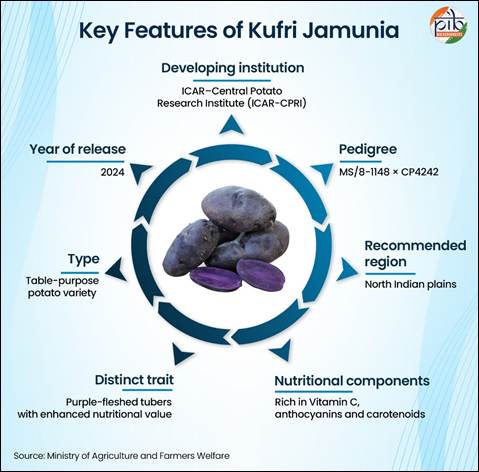
On 18 October 2026, the Press Information Bureau published a detailed backgrounder on Kufri Jamunia, a nutrient-rich purple potato variety developed by the ICAR–Central Potato Research Institute. The backgrounder highlights its enhanced vitamin, mineral and antioxidant content, agricultural productivity and potential contribution to nutritional security. Importantly, the variety was officially released in 2024; October 2026 marks the publication of the backgrounder, not its original release.
2. Developing Institution
Kufri Jamunia was developed by the Indian Council of Agricultural Research–Central Potato Research Institute, abbreviated ICAR–CPRI. The institute undertakes scientific research relating to potato varieties, cultivation, productivity and related agricultural technologies.
3. What Is Kufri Jamunia?
Kufri Jamunia is a potato variety with dark-purple skin and purple flesh. It has been developed to combine desirable agricultural characteristics with an improved nutritional profile. Its distinctive colour comes from naturally occurring plant pigments.
4. Official Release Year
The variety was officially released in 2024. This date must be distinguished from 18 October 2026, when PIB published a backgrounder describing its characteristics and significance.
5. What Is Hidden Hunger?
Hidden hunger refers to deficiencies of essential vitamins and minerals even when a person consumes enough calories. A diet may provide sufficient energy but still lack important micronutrients required for normal health and development.
6. What Is Biofortification?
Biofortification involves improving the nutritional content of crops through agricultural breeding and related crop-development methods. The objective is to increase beneficial nutrients in foods that people already consume regularly.
7. Biofortification Versus Food Fortification
Biofortification improves the nutrient profile of a crop during its development. Conventional food fortification adds nutrients to food during processing or preparation. Both approaches can contribute to nutritional improvement, but they operate at different stages of food production.
8. Why Potatoes?
Potatoes are widely consumed in India and are used in many household dishes. Improving the nutrient content of such a commonly eaten crop offers a potential route for increasing micronutrient intake without requiring consumers to adopt an entirely unfamiliar food.
9. Purple Colour and Plant Pigments
The purple colour of Kufri Jamunia is associated with anthocyanins, naturally occurring plant pigments. Anthocyanins belong to a group of compounds known as flavonoids and are studied for their antioxidant properties.
10. Meaning of Antioxidants
Antioxidants are substances capable of limiting certain oxidation reactions. Their presence in food is nutritionally relevant, but the antioxidant content of a crop alone does not establish that eating it will prevent or cure a particular disease.
11. Vitamin C Content
According to the PIB backgrounder, Kufri Jamunia contains approximately 42.75 milligrams of vitamin C per 100 grams of flesh. The conventional potato used in the official comparison contains approximately 23.15 milligrams per 100 grams.
12. Role of Vitamin C
Vitamin C, also called ascorbic acid, is an essential nutrient involved in normal collagen formation and several metabolic processes. It also supports normal immune function and helps the body absorb non-haem iron from plant-based foods.
13. Zinc Content
The official comparison reports approximately 2.28 milligrams of zinc per 100 grams of Kufri Jamunia, compared with approximately 0.28 milligrams in the conventional potato used for comparison.
14. Importance of Zinc
Zinc is an essential micronutrient involved in numerous biological processes, including enzyme function, normal growth and immune function. Adequate dietary zinc is important, particularly during periods of growth.
15. Iron Content
The official comparison reports approximately 3.22 milligrams of iron per 100 grams of Kufri Jamunia, compared with approximately 0.57 milligrams per 100 grams in the conventional potato used for comparison.
16. Importance of Iron
Iron is necessary for the formation of haemoglobin, which helps transport oxygen in the blood. Insufficient iron intake or absorption can contribute to iron deficiency. However, iron content in a food does not automatically indicate how much iron the body will absorb.
17. Anthocyanins in the Flesh
Kufri Jamunia contains approximately 42.05 milligrams of anthocyanins per 100 grams of flesh, according to the official backgrounder. These compounds contribute to the purple pigmentation.
18. Anthocyanins in the Skin
The skin contains approximately 80.66 milligrams of anthocyanins per 100 grams. The difference between flesh and skin demonstrates that nutrient and pigment concentrations can vary between different parts of a crop.
19. Carotenoid Content
The variety contains approximately 161 micrograms of carotenoids per 100 grams of fresh flesh. Carotenoids are naturally occurring pigments found in many plants. Different carotenoids have different nutritional and biological functions.
20. Plant Characteristics
Kufri Jamunia is described as a medium-maturing variety with medium-tall plants and a semi-compact canopy. These characteristics are relevant to agricultural identification and crop management.
21. Tuber Characteristics
The tubers have dark-purple skin, purple flesh, an oblong shape, shallow eyes and a mealy texture. These characteristics distinguish the variety from many commonly cultivated potatoes.
22. Tubers Per Plant
A Kufri Jamunia plant typically produces approximately 10–12 medium to large tubers, according to the PIB backgrounder. Actual output can vary with cultivation conditions and management.
23. Yield Under Recommended Cultivation
The backgrounder reports yields of approximately 32–35 tonnes per hectare under recommended cultivation practices. This is an agricultural performance figure, not a guarantee for every farm.
24. Yield in Station Trials
Station trials recorded yields of approximately 49 tonnes per hectare over a 90-day duration. Trial results should be distinguished from expected performance under ordinary farming conditions.
25. Marketable Yield
The variety recorded marketable yield approaching 90% of total production in trials. Marketable yield refers to the portion of harvested produce considered suitable for sale under the applicable grading criteria.
26. Dormancy Period
Kufri Jamunia has a medium dormancy period of approximately six to eight weeks. Dormancy describes the period during which harvested tubers do not readily begin sprouting.
27. Storage Characteristics
The official backgrounder reports good storage performance, relatively low rotting and limited weight loss. Storage quality matters because post-harvest deterioration can reduce farmers' saleable output.
28. Other Coloured Potato Varieties
ICAR–CPRI has also developed Kufri Neelkanth and Kufri Manik. These varieties illustrate ongoing work on potatoes with distinctive colours and improved nutritional characteristics.
29. Kufri Neelkanth
Kufri Neelkanth was released in 2018 and is described as the first purple-skinned specialty potato developed by ICAR–CPRI. It is associated with high antioxidant content and suitability for cultivation in several Indian states.
30. Kufri Manik
Kufri Manik was released in 2021. It produces deep-red tubers with yellow flesh and is reported to contain anthocyanins, zinc and iron. It should not be confused with the purple-fleshed Kufri Jamunia.
31. Comparative Nutritional Improvement
The PIB backgrounder identifies Kufri Jamunia as having higher levels of ascorbic acid, anthocyanins and carotenoids than Kufri Manik and Kufri Neelkanth. Its enhanced zinc and iron content is also an important feature.
32. Culinary Uses
Kufri Jamunia can be used in traditional foods such as vegetable curry, paratha, puri and raita. Its colour may also make it attractive for dishes where appearance and presentation are important.
33. Breakfast and Snack Products
Potential preparations include daliya, halwa, upma, dosa and idli batter. Its use in these foods illustrates that the variety is not restricted to a single type of cuisine.
34. Processed Food Applications
Kufri Jamunia can be processed into potato flour and other dehydrated ingredients for bakery products, soups and cookies. The PIB backgrounder also mentions anthocyanin-rich daliya and suji preparations.
35. Suitable Cultivation Region
The variety has demonstrated performance in multi-location trials and is recommended for cultivation in the North Indian plains. Farmers should consider locally recommended agronomic practices and climatic suitability before adoption.
36. Benefits for Farmers
Potential benefits include a distinctive product, marketable yield, storage performance and opportunities in fresh and processed food markets. Actual financial returns depend on production costs, consumer demand, prices and supply chains.
37. Benefits for Consumers
The variety offers an alternative potato with an improved nutrient profile and distinctive colour. It can contribute to dietary diversity, but a balanced diet remains essential for meeting overall nutritional requirements.
38. Role in Nutritional Security
Biofortified staple crops may support strategies for improving micronutrient intake among populations that consume them regularly. Their effectiveness depends on accessibility, consumption patterns, nutrient retention during cooking and nutrient absorption.
39. Important Scientific Caution
Higher measured nutrient levels do not establish that Kufri Jamunia cures anaemia, eliminates malnutrition or prevents specific diseases. Such claims would require additional clinical and population-level evidence.
40. Overall Significance
Kufri Jamunia illustrates how agricultural research can connect crop improvement with public nutrition. By combining purple pigmentation, enhanced micronutrient content, practical agricultural characteristics and food-processing potential, the variety represents a promising approach to nutritional security and agricultural innovation.
क्या हुआ?
1. चर्चा में क्यों?
18 अक्टूबर 2026 को प्रेस सूचना ब्यूरो ने कुफरी जामुनिया नामक पोषक तत्वों से भरपूर बैंगनी आलू पर विस्तृत पृष्ठभूमि लेख प्रकाशित किया। इस किस्म को भारतीय कृषि अनुसंधान परिषद के केंद्रीय आलू अनुसंधान संस्थान ने विकसित किया है। लेख में इसकी विटामिन, खनिज और प्रतिऑक्सीकारक संबंधी विशेषताओं, कृषि उत्पादकता तथा पोषण सुरक्षा में संभावित योगदान का उल्लेख है। महत्वपूर्ण बात यह है कि इस किस्म को आधिकारिक रूप से 2024 में जारी किया गया था; अक्टूबर 2026 में इसका नया पृष्ठभूमि लेख प्रकाशित हुआ है।
2. विकसित करने वाली संस्था
कुफरी जामुनिया को भारतीय कृषि अनुसंधान परिषद के केंद्रीय आलू अनुसंधान संस्थान ने विकसित किया है। यह संस्थान आलू की किस्मों, खेती, उत्पादकता और संबंधित कृषि तकनीकों पर वैज्ञानिक अनुसंधान करता है।
3. कुफरी जामुनिया क्या है?
कुफरी जामुनिया आलू की ऐसी किस्म है जिसकी बाहरी त्वचा गहरे बैंगनी रंग की और भीतरी गूदा बैंगनी रंग का होता है। इसे उपयोगी कृषि विशेषताओं के साथ बेहतर पोषण गुणों को जोड़ने के उद्देश्य से विकसित किया गया है। इसका विशिष्ट रंग प्राकृतिक वनस्पति वर्णकों से प्राप्त होता है।
4. आधिकारिक जारी होने का वर्ष
इस किस्म को आधिकारिक रूप से 2024 में जारी किया गया था। इस तिथि को 18 अक्टूबर 2026 से अलग समझना चाहिए, जब प्रेस सूचना ब्यूरो ने इसकी विशेषताओं और महत्व पर पृष्ठभूमि लेख प्रकाशित किया।
5. छिपी हुई भूख क्या है?
छिपी हुई भूख का अर्थ है पर्याप्त कैलोरी मिलने के बावजूद आवश्यक विटामिन और खनिजों की कमी होना। किसी व्यक्ति के भोजन से पर्याप्त ऊर्जा मिल सकती है, लेकिन सामान्य स्वास्थ्य और विकास के लिए आवश्यक सूक्ष्म पोषक तत्वों की कमी बनी रह सकती है।
6. जैव-संवर्धन क्या है?
जैव-संवर्धन में कृषि प्रजनन और फसल विकास की संबंधित विधियों के माध्यम से फसलों में पोषक तत्वों की मात्रा बढ़ाई जाती है। इसका उद्देश्य उन खाद्य पदार्थों के पोषण गुण सुधारना है जिनका लोग नियमित रूप से सेवन करते हैं।
7. जैव-संवर्धन और खाद्य पोषक-संवर्धन में अंतर
जैव-संवर्धन फसल के विकास के दौरान उसके पोषण गुणों में सुधार करता है। सामान्य खाद्य पोषक-संवर्धन में खाद्य प्रसंस्करण या तैयारी के दौरान पोषक तत्व मिलाए जाते हैं। दोनों विधियां पोषण सुधार में सहायक हो सकती हैं, लेकिन खाद्य उत्पादन के अलग-अलग चरणों में काम करती हैं।
8. आलू का चयन क्यों महत्वपूर्ण है?
भारत में आलू व्यापक रूप से खाया जाता है और अनेक घरेलू व्यंजनों में उपयोग होता है। इतनी सामान्य खाद्य फसल के पोषण गुण सुधारने से लोगों को पूरी तरह अपरिचित खाद्य पदार्थ अपनाए बिना सूक्ष्म पोषक तत्वों का सेवन बढ़ाने का अवसर मिल सकता है।
9. बैंगनी रंग और वनस्पति वर्णक
कुफरी जामुनिया का बैंगनी रंग एंथोसाइनिन नामक प्राकृतिक वनस्पति वर्णकों से संबंधित है। एंथोसाइनिन फ्लेवोनॉयड नामक यौगिकों के समूह में आते हैं और इनके प्रतिऑक्सीकारक गुणों का अध्ययन किया जाता है।
10. प्रतिऑक्सीकारकों का अर्थ
प्रतिऑक्सीकारक ऐसे पदार्थ होते हैं जो कुछ ऑक्सीकरण प्रतिक्रियाओं को सीमित करने में सक्षम होते हैं। भोजन में इनकी उपस्थिति पोषण की दृष्टि से महत्वपूर्ण है, लेकिन केवल किसी फसल में इनकी मात्रा अधिक होने से यह सिद्ध नहीं होता कि उसे खाने से कोई विशेष बीमारी रोकी या ठीक की जा सकती है।
11. विटामिन C की मात्रा
PIB के अनुसार कुफरी जामुनिया के प्रत्येक 100 ग्राम गूदे में लगभग 42.75 मिलीग्राम विटामिन C पाया जाता है। आधिकारिक तुलना में उपयोग किए गए सामान्य आलू में यह मात्रा लगभग 23.15 मिलीग्राम प्रति 100 ग्राम है।
12. विटामिन C की भूमिका
विटामिन C को एस्कॉर्बिक अम्ल भी कहा जाता है। यह सामान्य कोलेजन निर्माण और कई चयापचय प्रक्रियाओं के लिए आवश्यक पोषक तत्व है। यह सामान्य प्रतिरक्षा कार्यों में सहायता करता है तथा वनस्पति खाद्य पदार्थों से मिलने वाले गैर-हीम लौह के अवशोषण को बढ़ाने में मदद करता है।
13. जिंक की मात्रा
आधिकारिक तुलना के अनुसार कुफरी जामुनिया के प्रत्येक 100 ग्राम में लगभग 2.28 मिलीग्राम जिंक है, जबकि तुलना में उपयोग किए गए सामान्य आलू में लगभग 0.28 मिलीग्राम जिंक है।
14. जिंक का महत्व
जिंक एक आवश्यक सूक्ष्म पोषक तत्व है जो अनेक जैविक प्रक्रियाओं, एंजाइमों के कार्य, सामान्य वृद्धि और प्रतिरक्षा कार्यों में भाग लेता है। विशेषकर विकास की अवस्थाओं में पर्याप्त जिंक का सेवन महत्वपूर्ण है।
15. लौह की मात्रा
आधिकारिक तुलना के अनुसार कुफरी जामुनिया के प्रत्येक 100 ग्राम में लगभग 3.22 मिलीग्राम लौह है, जबकि सामान्य आलू में लगभग 0.57 मिलीग्राम लौह है।
16. लौह का महत्व
लौह हीमोग्लोबिन के निर्माण के लिए आवश्यक है, जो रक्त में ऑक्सीजन के परिवहन में सहायता करता है। लौह का अपर्याप्त सेवन या अवशोषण लौह की कमी में योगदान दे सकता है। हालांकि किसी खाद्य पदार्थ में लौह की मात्रा से यह स्वतः निर्धारित नहीं होता कि शरीर कितना लौह अवशोषित करेगा।
17. गूदे में एंथोसाइनिन
आधिकारिक पृष्ठभूमि लेख के अनुसार कुफरी जामुनिया के प्रत्येक 100 ग्राम गूदे में लगभग 42.05 मिलीग्राम एंथोसाइनिन पाया जाता है। ये यौगिक बैंगनी रंग उत्पन्न करने में योगदान देते हैं।
18. त्वचा में एंथोसाइनिन
इसकी बाहरी त्वचा के प्रत्येक 100 ग्राम में लगभग 80.66 मिलीग्राम एंथोसाइनिन पाया जाता है। गूदे और त्वचा के बीच यह अंतर दर्शाता है कि फसल के विभिन्न भागों में पोषक तत्वों और वर्णकों की मात्रा अलग हो सकती है।
19. कैरोटिनॉयड की मात्रा
इस किस्म के प्रत्येक 100 ग्राम ताजे गूदे में लगभग 161 माइक्रोग्राम कैरोटिनॉयड पाया जाता है। कैरोटिनॉयड अनेक पौधों में मिलने वाले प्राकृतिक वर्णक हैं। विभिन्न कैरोटिनॉयड के पोषण और जैविक कार्य अलग-अलग होते हैं।
20. पौधे की विशेषताएं
कुफरी जामुनिया मध्यम अवधि में तैयार होने वाली किस्म है। इसके पौधे मध्यम ऊंचाई के होते हैं और पत्तियों का फैलाव अर्ध-सघन होता है। ये विशेषताएं फसल की पहचान और कृषि प्रबंधन के लिए उपयोगी हैं।
21. कंद की विशेषताएं
इसके कंदों की त्वचा गहरे बैंगनी रंग की, गूदा बैंगनी, आकार लंबोतरा, आंखें उथली और बनावट अपेक्षाकृत भुरभुरी होती है। ये गुण इसे सामान्यतः उगाए जाने वाले अनेक आलुओं से अलग पहचान देते हैं।
22. प्रति पौधा कंदों की संख्या
PIB के अनुसार कुफरी जामुनिया का एक पौधा सामान्यतः मध्यम से बड़े आकार के लगभग 10–12 कंद उत्पन्न करता है। वास्तविक उत्पादन खेती की परिस्थितियों और प्रबंधन के अनुसार बदल सकता है।
23. अनुशंसित खेती में उपज
आधिकारिक पृष्ठभूमि लेख के अनुसार अनुशंसित खेती की पद्धतियों में लगभग 32–35 टन प्रति हेक्टेयर उपज प्राप्त होती है। यह कृषि प्रदर्शन का आंकड़ा है, प्रत्येक खेत के लिए निश्चित उत्पादन की गारंटी नहीं।
24. अनुसंधान केंद्र परीक्षणों में उपज
अनुसंधान केंद्र परीक्षणों में 90 दिनों की अवधि में लगभग 49 टन प्रति हेक्टेयर उपज दर्ज की गई। परीक्षण परिणामों को सामान्य खेती की परिस्थितियों में अपेक्षित उत्पादन से अलग समझना चाहिए।
25. बाजार योग्य उपज
परीक्षणों में कुल उत्पादन का लगभग 90 प्रतिशत भाग बाजार योग्य पाया गया। बाजार योग्य उपज का अर्थ कटाई के बाद प्राप्त उस उत्पादन से है जिसे संबंधित गुणवत्ता मानदंडों के अनुसार बिक्री के योग्य माना जाता है।
26. सुप्तावस्था की अवधि
कुफरी जामुनिया की सुप्तावस्था लगभग छह से आठ सप्ताह की होती है। सुप्तावस्था वह अवधि है जिसके दौरान कटाई के बाद कंदों में सामान्यतः जल्दी अंकुरण शुरू नहीं होता।
27. भंडारण संबंधी विशेषताएं
आधिकारिक लेख के अनुसार इस किस्म की भंडारण क्षमता अच्छी है तथा सड़न और वजन में कमी अपेक्षाकृत कम होती है। भंडारण गुणवत्ता महत्वपूर्ण है क्योंकि कटाई के बाद खराब होने से किसानों का बिक्री योग्य उत्पादन घट सकता है।
28. रंगीन आलू की अन्य किस्में
केंद्रीय आलू अनुसंधान संस्थान ने कुफरी नीलकंठ और कुफरी माणिक भी विकसित किए हैं। ये किस्में विशिष्ट रंग और बेहतर पोषण गुणों वाले आलुओं पर जारी अनुसंधान को दर्शाती हैं।
29. कुफरी नीलकंठ
कुफरी नीलकंठ को 2018 में जारी किया गया था। इसे केंद्रीय आलू अनुसंधान संस्थान द्वारा विकसित पहली बैंगनी त्वचा वाली विशेष आलू किस्म बताया गया है। यह अधिक प्रतिऑक्सीकारक सामग्री और भारत के कई राज्यों में खेती की उपयुक्तता के लिए जानी जाती है।
30. कुफरी माणिक
कुफरी माणिक को 2021 में जारी किया गया था। इसके कंद गहरे लाल रंग के और गूदा पीले रंग का होता है। इसमें एंथोसाइनिन, जिंक और लौह की उपस्थिति बताई गई है। इसे बैंगनी गूदे वाली कुफरी जामुनिया से अलग समझना चाहिए।
31. तुलनात्मक पोषण सुधार
PIB के अनुसार कुफरी जामुनिया में कुफरी माणिक और कुफरी नीलकंठ की तुलना में एस्कॉर्बिक अम्ल, एंथोसाइनिन और कैरोटिनॉयड की मात्रा अधिक है। इसमें जिंक और लौह की बढ़ी हुई मात्रा भी महत्वपूर्ण विशेषता है।
32. भोजन में उपयोग
कुफरी जामुनिया का उपयोग सब्जी, पराठा, पूरी और रायता जैसे पारंपरिक खाद्य पदार्थों में किया जा सकता है। इसका रंग ऐसे व्यंजनों में भी आकर्षक हो सकता है जहां भोजन की सजावट और प्रस्तुति महत्वपूर्ण होती है।
33. नाश्ते और हल्के खाद्य पदार्थों में उपयोग
इसके संभावित उपयोगों में दलिया, हलवा, उपमा, डोसा और इडली का घोल शामिल हैं। इन उदाहरणों से स्पष्ट है कि यह किस्म केवल एक प्रकार के भोजन तक सीमित नहीं है।
34. प्रसंस्कृत खाद्य पदार्थों में उपयोग
कुफरी जामुनिया से आलू का आटा और अन्य निर्जलित सामग्री तैयार की जा सकती है, जिनका उपयोग बेकरी उत्पादों, सूप और बिस्कुट में हो सकता है। PIB ने एंथोसाइनिन युक्त दलिया और सूजी जैसी तैयारियों का भी उल्लेख किया है।
35. उपयुक्त खेती का क्षेत्र
बहु-स्थान परीक्षणों में इस किस्म ने उपयोगी प्रदर्शन किया है और इसे उत्तर भारत के मैदानी क्षेत्रों में खेती के लिए अनुशंसित किया गया है। किसानों को इसे अपनाने से पहले स्थानीय कृषि अनुशंसाओं और जलवायु की उपयुक्तता पर विचार करना चाहिए।
36. किसानों के लिए लाभ
इसके संभावित लाभों में विशिष्ट उत्पाद, बाजार योग्य उपज, भंडारण क्षमता और ताजे तथा प्रसंस्कृत खाद्य बाजारों में अवसर शामिल हैं। वास्तविक आर्थिक लाभ उत्पादन लागत, उपभोक्ता मांग, कीमतों और आपूर्ति शृंखला पर निर्भर करेंगे।
37. उपभोक्ताओं के लिए लाभ
यह किस्म बेहतर पोषण गुणों और विशिष्ट रंग वाला वैकल्पिक आलू उपलब्ध कराती है। यह आहार विविधता में योगदान दे सकती है, लेकिन संपूर्ण पोषण आवश्यकताओं को पूरा करने के लिए संतुलित आहार आवश्यक बना रहता है।
38. पोषण सुरक्षा में भूमिका
जैव-संवर्धित प्रमुख खाद्य फसलें उन समुदायों में सूक्ष्म पोषक तत्वों का सेवन सुधारने की रणनीतियों का समर्थन कर सकती हैं जो नियमित रूप से इनका उपयोग करते हैं। प्रभावशीलता उपलब्धता, भोजन की आदतों, पकाने के दौरान पोषक तत्वों के संरक्षण और शरीर में उनके अवशोषण पर निर्भर करती है।
39. महत्वपूर्ण वैज्ञानिक सावधानी
पोषक तत्वों की अधिक मात्रा होने से यह सिद्ध नहीं होता कि कुफरी जामुनिया रक्ताल्पता ठीक कर सकती है, कुपोषण पूरी तरह समाप्त कर सकती है या किसी विशेष रोग को रोक सकती है। ऐसे दावों के लिए अतिरिक्त चिकित्सकीय और जनसंख्या-आधारित प्रमाण आवश्यक होंगे।
40. समग्र महत्व
कुफरी जामुनिया दर्शाती है कि कृषि अनुसंधान के माध्यम से फसल सुधार को सार्वजनिक पोषण से जोड़ा जा सकता है। बैंगनी वर्णक, बढ़े हुए सूक्ष्म पोषक तत्व, उपयोगी कृषि विशेषताएं और खाद्य प्रसंस्करण की संभावनाओं को मिलाकर यह किस्म पोषण सुरक्षा तथा कृषि नवाचार की दिशा में आशाजनक प्रयास प्रस्तुत करती है।
Key Facts
• PIB published its Kufri Jamunia backgrounder on 18 October 2026.
• The official release ID is 2324875.
• Kufri Jamunia is a nutrient-rich purple potato variety.
• The developing institution is ICAR–Central Potato Research Institute.
• ICAR stands for Indian Council of Agricultural Research.
• CPRI stands for Central Potato Research Institute.
• Kufri Jamunia was officially released in 2024.
• The potato has dark-purple skin.
• The potato has purple flesh.
• Its purple pigmentation is associated with anthocyanins.
• Anthocyanins are naturally occurring plant pigments.
• Anthocyanins belong to the flavonoid group of compounds.
• The variety contains vitamin C, zinc, iron and carotenoids.
• Vitamin C content in the flesh is approximately 42.75 mg per 100 g.
• Vitamin C content in the conventional comparison potato is 23.15 mg per 100 g.
• Zinc content is approximately 2.28 mg per 100 g.
• Zinc in the conventional comparison potato is approximately 0.28 mg per 100 g.
• Iron content is approximately 3.22 mg per 100 g.
• Iron in the conventional comparison potato is approximately 0.57 mg per 100 g.
• Anthocyanin content in the flesh is approximately 42.05 mg per 100 g.
• Anthocyanin content in the skin is approximately 80.66 mg per 100 g.
• Carotenoid content is approximately 161 micrograms per 100 g of fresh flesh.
• Kufri Jamunia is a medium-maturing potato variety.
• Its plants are medium-tall with a semi-compact canopy.
• Its tubers are oblong with shallow eyes.
• Its tubers have a mealy texture.
• Each plant produces approximately 10–12 medium to large tubers.
• Recommended-practice yields are approximately 32–35 tonnes per hectare.
• Station trials recorded approximately 49 tonnes per hectare.
• The cited station-trial duration was 90 days.
• Marketable yield approached 90% of total production in trials.
• The dormancy period is approximately six to eight weeks.
• The variety has good reported storage characteristics.
• Kufri Neelkanth was released in 2018.
• Kufri Neelkanth is a purple-skinned specialty potato.
• Kufri Manik was released in 2021.
• Kufri Manik has deep-red tubers and yellow flesh.
• Kufri Jamunia was released after Kufri Neelkanth and Kufri Manik.
• Kufri Jamunia has higher levels of selected antioxidant-related compounds than the two earlier varieties.
• The variety can be used in vegetable curry and paratha.
• It can also be used in puri and raita.
• It can be used in daliya, halwa and upma.
• Potential applications include dosa and idli batter.
• Processed applications include potato flour, bakery items, soups and cookies.
• The variety is recommended for cultivation in the North Indian plains.
• Hidden hunger refers to micronutrient deficiency despite sufficient calorie intake.
• Biofortification improves the nutrient content of crops.
• Conventional food fortification adds nutrients during processing.
• The variety has potential applications in nutritional security and agricultural innovation.
• The October 2026 PIB article is a backgrounder, not the original release announcement.
मुख्य तथ्य
• PIB ने कुफरी जामुनिया पर पृष्ठभूमि लेख 18 अक्टूबर 2026 को प्रकाशित किया।
• आधिकारिक विज्ञप्ति संख्या 2324875 है।
• कुफरी जामुनिया पोषक तत्वों से भरपूर बैंगनी आलू की किस्म है।
• इसे भारतीय कृषि अनुसंधान परिषद के केंद्रीय आलू अनुसंधान संस्थान ने विकसित किया।
• ICAR का पूरा नाम Indian Council of Agricultural Research है।
• CPRI का पूरा नाम Central Potato Research Institute है।
• कुफरी जामुनिया को आधिकारिक रूप से 2024 में जारी किया गया।
• इस आलू की त्वचा गहरे बैंगनी रंग की होती है।
• इस आलू का गूदा बैंगनी रंग का होता है।
• इसका बैंगनी रंग एंथोसाइनिन से संबंधित है।
• एंथोसाइनिन प्राकृतिक वनस्पति वर्णक हैं।
• एंथोसाइनिन फ्लेवोनॉयड समूह के यौगिक हैं।
• इस किस्म में विटामिन C, जिंक, लौह और कैरोटिनॉयड पाए जाते हैं।
• गूदे में विटामिन C की मात्रा लगभग 42.75 मिलीग्राम प्रति 100 ग्राम है।
• तुलना में उपयोग किए गए सामान्य आलू में विटामिन C लगभग 23.15 मिलीग्राम प्रति 100 ग्राम है।
• जिंक की मात्रा लगभग 2.28 मिलीग्राम प्रति 100 ग्राम है।
• सामान्य तुलना वाले आलू में जिंक लगभग 0.28 मिलीग्राम प्रति 100 ग्राम है।
• लौह की मात्रा लगभग 3.22 मिलीग्राम प्रति 100 ग्राम है।
• सामान्य तुलना वाले आलू में लौह लगभग 0.57 मिलीग्राम प्रति 100 ग्राम है।
• गूदे में एंथोसाइनिन लगभग 42.05 मिलीग्राम प्रति 100 ग्राम है।
• त्वचा में एंथोसाइनिन लगभग 80.66 मिलीग्राम प्रति 100 ग्राम है।
• ताजे गूदे में कैरोटिनॉयड लगभग 161 माइक्रोग्राम प्रति 100 ग्राम है।
• कुफरी जामुनिया मध्यम अवधि में तैयार होने वाली किस्म है।
• इसके पौधे मध्यम ऊंचाई के और अर्ध-सघन पत्तियों वाले होते हैं।
• इसके कंद लंबोतरे होते हैं और उनकी आंखें उथली होती हैं।
• इसके कंदों की बनावट अपेक्षाकृत भुरभुरी होती है।
• प्रति पौधा लगभग 10–12 मध्यम से बड़े कंद प्राप्त होते हैं।
• अनुशंसित खेती में उपज लगभग 32–35 टन प्रति हेक्टेयर है।
• अनुसंधान केंद्र परीक्षणों में लगभग 49 टन प्रति हेक्टेयर उपज दर्ज हुई।
• उल्लिखित अनुसंधान केंद्र परीक्षण की अवधि 90 दिन थी।
• परीक्षणों में बाजार योग्य उपज कुल उत्पादन के लगभग 90 प्रतिशत तक पहुंची।
• सुप्तावस्था लगभग छह से आठ सप्ताह की होती है।
• इस किस्म की भंडारण संबंधी विशेषताएं अच्छी बताई गई हैं।
• कुफरी नीलकंठ को 2018 में जारी किया गया।
• कुफरी नीलकंठ बैंगनी त्वचा वाली विशेष आलू किस्म है।
• कुफरी माणिक को 2021 में जारी किया गया।
• कुफरी माणिक के कंद गहरे लाल और गूदा पीले रंग का होता है।
• कुफरी जामुनिया को कुफरी नीलकंठ और कुफरी माणिक के बाद जारी किया गया।
• कुफरी जामुनिया में पहले की दोनों किस्मों की तुलना में कुछ प्रतिऑक्सीकारक संबंधी यौगिकों की मात्रा अधिक है।
• इस किस्म का उपयोग सब्जी और पराठे में किया जा सकता है।
• इसका उपयोग पूरी और रायते में भी किया जा सकता है।
• इसका उपयोग दलिया, हलवा और उपमा में किया जा सकता है।
• इसके संभावित उपयोगों में डोसा और इडली का घोल शामिल है।
• प्रसंस्कृत उपयोगों में आलू का आटा, बेकरी उत्पाद, सूप और बिस्कुट शामिल हैं।
• इस किस्म को उत्तर भारत के मैदानी क्षेत्रों में खेती के लिए अनुशंसित किया गया है।
• छिपी हुई भूख का अर्थ पर्याप्त कैलोरी के बावजूद सूक्ष्म पोषक तत्वों की कमी है।
• जैव-संवर्धन फसलों में पोषक तत्वों की मात्रा सुधारता है।
• सामान्य खाद्य पोषक-संवर्धन में प्रसंस्करण के दौरान पोषक तत्व मिलाए जाते हैं।
• इस किस्म में पोषण सुरक्षा और कृषि नवाचार से संबंधित संभावनाएं हैं।
• अक्टूबर 2026 का PIB लेख पृष्ठभूमि लेख है, मूल जारी करने की घोषणा नहीं।
Background
Hidden hunger is a form of nutritional deficiency in which a person may consume sufficient calories but fail to obtain adequate vitamins and minerals. Agricultural scientists have therefore explored biofortification, which improves the nutrient content of crops through breeding and crop development. The Indian Council of Agricultural Research–Central Potato Research Institute has developed several nutrient-rich coloured potato varieties, including Kufri Neelkanth, released in 2018, Kufri Manik, released in 2021, and Kufri Jamunia, officially released in 2024. Kufri Jamunia is distinguished by dark-purple skin, purple flesh and enhanced levels of selected nutrients and antioxidant compounds. The PIB backgrounder published on 18 October 2026 reports approximately 42.75 mg of vitamin C, 2.28 mg of zinc and 3.22 mg of iron per 100 g in its nutritional comparison. The variety produces approximately 10–12 tubers per plant and yields around 32–35 tonnes per hectare under recommended cultivation practices. Its potential significance lies in combining agricultural productivity, food-processing versatility and improved nutritional characteristics.
पृष्ठभूमि
छिपी हुई भूख पोषण संबंधी कमी की ऐसी स्थिति है जिसमें व्यक्ति पर्याप्त कैलोरी प्राप्त करने के बावजूद आवश्यक विटामिन और खनिजों की पर्याप्त मात्रा नहीं प्राप्त कर पाता। इसी कारण कृषि वैज्ञानिकों ने जैव-संवर्धन पर कार्य किया है, जिसके माध्यम से प्रजनन और फसल विकास की विधियों द्वारा पोषक तत्वों की मात्रा बढ़ाई जाती है। भारतीय कृषि अनुसंधान परिषद के केंद्रीय आलू अनुसंधान संस्थान ने कई पोषक तत्वों से भरपूर रंगीन आलू की किस्में विकसित की हैं। इनमें 2018 में जारी कुफरी नीलकंठ, 2021 में जारी कुफरी माणिक और 2024 में आधिकारिक रूप से जारी कुफरी जामुनिया शामिल हैं। कुफरी जामुनिया गहरे बैंगनी रंग की त्वचा, बैंगनी गूदे तथा कुछ पोषक तत्वों और प्रतिऑक्सीकारक यौगिकों की अधिक मात्रा के कारण विशिष्ट है। 18 अक्टूबर 2026 को प्रकाशित PIB पृष्ठभूमि लेख में पोषण संबंधी तुलना के अनुसार प्रत्येक 100 ग्राम में लगभग 42.75 मिलीग्राम विटामिन C, 2.28 मिलीग्राम जिंक और 3.22 मिलीग्राम लौह का उल्लेख है। यह किस्म प्रति पौधा लगभग 10–12 कंद देती है और अनुशंसित खेती में लगभग 32–35 टन प्रति हेक्टेयर उपज प्रदान करती है। इसका संभावित महत्व कृषि उत्पादकता, खाद्य प्रसंस्करण की विविधता और बेहतर पोषण विशेषताओं को एक साथ जोड़ने में है।
Why It Matters
Kufri Jamunia is significant for agricultural science, public nutrition and rural development. It demonstrates how crop improvement can address both farm productivity and the nutritional composition of commonly consumed foods. The variety contains higher levels of selected micronutrients than the conventional potato used in the official comparison, potentially contributing to dietary diversity. Its yield, storage characteristics and food-processing applications may provide opportunities for farmers and food businesses. The research also illustrates the distinction between biofortification and conventional food fortification, an important topic in science and public-health examinations. However, improved nutrient composition should not be confused with proven treatment of nutritional diseases. Wider benefits depend on cultivation, affordability, availability, cooking practices and nutritional outcomes.
यह क्यों महत्वपूर्ण है?
कुफरी जामुनिया कृषि विज्ञान, सार्वजनिक पोषण और ग्रामीण विकास के लिए महत्वपूर्ण है। यह दर्शाती है कि फसल सुधार के माध्यम से कृषि उत्पादकता और सामान्यतः खाए जाने वाले खाद्य पदार्थों की पोषण संरचना दोनों पर ध्यान दिया जा सकता है। आधिकारिक तुलना में उपयोग किए गए सामान्य आलू की अपेक्षा इसमें कुछ सूक्ष्म पोषक तत्वों की मात्रा अधिक है, जिससे आहार विविधता में संभावित योगदान मिल सकता है। इसकी उपज, भंडारण संबंधी विशेषताएं और खाद्य प्रसंस्करण के उपयोग किसानों तथा खाद्य व्यवसायों के लिए अवसर पैदा कर सकते हैं। यह अनुसंधान जैव-संवर्धन और सामान्य खाद्य पोषक-संवर्धन के बीच अंतर भी स्पष्ट करता है, जो विज्ञान और सार्वजनिक स्वास्थ्य संबंधी परीक्षाओं का महत्वपूर्ण विषय है। हालांकि बेहतर पोषण संरचना को पोषण संबंधी रोगों के सिद्ध उपचार के समान नहीं समझना चाहिए। व्यापक लाभ खेती, वहनीयता, उपलब्धता, पकाने की पद्धतियों और वास्तविक पोषण परिणामों पर निर्भर करेंगे।
Exam Connection
Important Examination Facts: Topic: Kufri Jamunia biofortified purple potato. PIB backgrounder date: 18 October 2026. Original variety release year: 2024. Developing institution: ICAR–Central Potato Research Institute. Skin colour: Dark purple. Flesh colour: Purple. Important pigment: Anthocyanins. Vitamin C: Approximately 42.75 mg per 100 g. Zinc: Approximately 2.28 mg per 100 g. Iron: Approximately 3.22 mg per 100 g. Anthocyanins in flesh: Approximately 42.05 mg per 100 g. Anthocyanins in skin: Approximately 80.66 mg per 100 g. Carotenoids in fresh flesh: Approximately 161 micrograms per 100 g. Tubers per plant: Approximately 10–12. Recommended-practice yield: Approximately 32–35 tonnes per hectare. Station-trial yield: Approximately 49 tonnes per hectare over 90 days. Marketable yield in trials: Nearly 90%. Dormancy: Approximately six to eight weeks. Related varieties: Kufri Neelkanth, released in 2018, and Kufri Manik, released in 2021. Main scientific concept: Biofortification. Main nutritional concept: Hidden hunger. Recommended broad cultivation region: North Indian plains. PIB release number: 2324875. Important caution: The variety was not newly released in October 2026.
परीक्षा से संबंध
परीक्षा के महत्वपूर्ण तथ्य: विषय: कुफरी जामुनिया जैव-संवर्धित बैंगनी आलू। PIB पृष्ठभूमि लेख की तिथि: 18 अक्टूबर 2026। किस्म के मूल जारी होने का वर्ष: 2024। विकसित करने वाली संस्था: भारतीय कृषि अनुसंधान परिषद–केंद्रीय आलू अनुसंधान संस्थान। त्वचा का रंग: गहरा बैंगनी। गूदे का रंग: बैंगनी। महत्वपूर्ण वर्णक: एंथोसाइनिन। विटामिन C: लगभग 42.75 मिलीग्राम प्रति 100 ग्राम। जिंक: लगभग 2.28 मिलीग्राम प्रति 100 ग्राम। लौह: लगभग 3.22 मिलीग्राम प्रति 100 ग्राम। गूदे में एंथोसाइनिन: लगभग 42.05 मिलीग्राम प्रति 100 ग्राम। त्वचा में एंथोसाइनिन: लगभग 80.66 मिलीग्राम प्रति 100 ग्राम। ताजे गूदे में कैरोटिनॉयड: लगभग 161 माइक्रोग्राम प्रति 100 ग्राम। प्रति पौधा कंद: लगभग 10–12। अनुशंसित खेती में उपज: लगभग 32–35 टन प्रति हेक्टेयर। अनुसंधान केंद्र परीक्षण में उपज: 90 दिनों में लगभग 49 टन प्रति हेक्टेयर। परीक्षणों में बाजार योग्य उपज: लगभग 90 प्रतिशत। सुप्तावस्था: लगभग छह से आठ सप्ताह। संबंधित किस्में: कुफरी नीलकंठ, 2018 और कुफरी माणिक, 2021। प्रमुख वैज्ञानिक अवधारणा: जैव-संवर्धन। प्रमुख पोषण अवधारणा: छिपी हुई भूख। अनुशंसित व्यापक खेती क्षेत्र: उत्तर भारत के मैदानी क्षेत्र। PIB विज्ञप्ति संख्या: 2324875। महत्वपूर्ण सावधानी: यह किस्म अक्टूबर 2026 में नई जारी नहीं की गई थी।
 History Geography General Science Economy
 SSC CGL 2026 Ultimate Chapterwise