1. Why in News?
On 29 October 2026, the Press Information Bureau published an official explainer titled Cloud Ecosystem in India: Building the Digital Foundation for Secure and Scalable Computing.
The publication highlighted the expansion of government cloud infrastructure, the MeghRaj initiative, data centre capacity, artificial intelligence computing resources and India's efforts to strengthen digital sovereignty.
This is a review of developments in India's cloud ecosystem, not the announcement of a newly approved cloud scheme.
2. Important Facts for Competitive Examinations
- Official publication: 29 October 2026.
- PIB Explainer ID: 160629.
- Key initiative: MeghRaj, Government of India's Cloud Ecosystem.
- MeghRaj launched: 2014.
- Nodal ministry: Ministry of Electronics and Information Technology.
- Government departments adopting MeghRaj: 2,330 by September 2026.
- Empanelled cloud service providers: 30 as of September 2026.
- Data centre capacity: 1.57 GW as of August 2026.
- Projected data centre capacity: Nearly 8 GW by 2030.
- IndiaAI Mission outlay: ₹10,371.92 crore.
- IndiaAI common computing facility: More than 45,000 GPUs onboarded.
- Cloud Selection Framework: Issued by MeitY in March 2026.
3. What Is Cloud Computing?
Cloud computing is the delivery of computing resources over a network, generally the internet.
These resources may include servers, storage, databases, networking, software and processing capacity.
Instead of purchasing and maintaining all physical computing equipment, an organisation can obtain resources from a cloud provider according to its requirements.
4. Why Cloud Computing Matters
Modern government services, digital payments, educational platforms, hospitals and businesses generate large quantities of digital information.
These services require reliable storage, computing power and continuous availability.
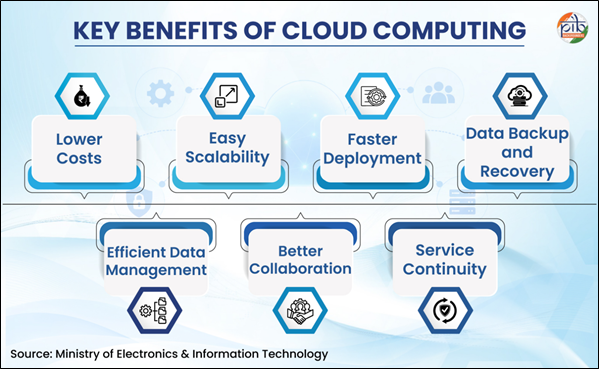
Cloud computing can make digital infrastructure easier to deploy, expand and manage, although its benefits depend on suitable architecture and security arrangements.
5. Growth of India's Digital Economy
According to the PIB explainer, India's internet subscriber base reached 1,092.79 million in March 2026.
Average wireless data consumption reached 25.51 GB per subscriber per month.
Total wireless data usage in financial year 2025-26 was reported at 285,376 petabytes.
These figures demonstrate the scale of demand placed on the country's digital infrastructure.
6. What Is a Data Centre?
A data centre is a facility that houses computing equipment, servers, storage systems and networking infrastructure.
Data centres also require power supply, cooling, physical security and systems to maintain service continuity.
Cloud platforms depend on data centres, although a single cloud service may operate across multiple facilities.
7. India's Data Centre Capacity
India's data centre capacity reached 1.57 gigawatts in August 2026, according to the official explainer.
Capacity is projected to approach 8 gigawatts by 2030.
This is a projection, not capacity already installed.
Growth will depend on investment, infrastructure development, electricity availability and market demand.
8. Major Data Centre Locations
The PIB publication identifies Mumbai, Navi Mumbai, Chennai, Hyderabad, Bengaluru, Delhi-NCR and Jamnagar among important cloud infrastructure locations.
It also notes emerging data centre activity in Andhra Pradesh, Madhya Pradesh, Chhattisgarh and West Bengal.
Geographic diversification can help distribute computing infrastructure and support regional digital development.
9. Cloud Service Providers in India
As of September 2026, India had empanelled 30 cloud service providers.
The official publication lists Indian providers including Jio Platforms, Tata Consultancy Services, BSNL, ITI, RailTel, AdaniConneX and Yotta Data Services.
It also identifies international providers including Google Cloud India, Oracle India, Microsoft India and Amazon Web Services India.
Empanelment does not imply that every provider is suitable for every government workload.
10. MeghRaj Initiative
MeghRaj is the Government of India's cloud ecosystem initiative.
It was launched in 2014 under the Ministry of Electronics and Information Technology.
Its purpose is to accelerate electronic governance and improve the efficiency of public expenditure on information and communication technology.
11. MeghRaj 2.0
MeghRaj 2.0 represents the next-generation government cloud environment.
It supports flexible cloud services through distributed infrastructure and is intended to help government departments deploy digital applications.
Its architecture supports different computing service models, including infrastructure, platform and software services.
12. Government Adoption
By September 2026, MeghRaj adoption had expanded to 2,330 government departments.
The official explainer associates the ecosystem with digital public services such as DigiLocker, MyGov, the National Scholarship Portal and the Department of Posts' Advanced Postal Technology.
The figure represents reported departmental adoption, not the number of individual cloud servers.
13. Public Cloud
A public cloud is operated by a provider that makes computing resources available to multiple customers.
Different customers may share underlying infrastructure while their workloads and information remain logically separated through technical controls.
Public cloud can offer flexibility and scalability, but users must assess security, compliance and contractual requirements.
14. Private Cloud
A private cloud is dedicated to one organisation.
It may provide greater control over infrastructure, access policies and deployment arrangements.
However, a private cloud does not automatically guarantee stronger security; effective protection still requires proper design and administration.
15. Hybrid Cloud
A hybrid cloud combines two or more computing environments, commonly private and public cloud infrastructure.
An organisation may use one environment for sensitive information and another for applications requiring flexible capacity.
Hybrid arrangements require careful coordination of identity, networking, monitoring and data protection.
16. Infrastructure as a Service
Infrastructure as a Service, abbreviated IaaS, provides computing resources such as virtual machines, storage and networking.
The customer generally manages its operating systems, applications and data, while the provider manages the underlying physical infrastructure.
IaaS is useful when organisations need control over their computing environment without owning all physical hardware.
17. Platform as a Service
Platform as a Service, abbreviated PaaS, provides a managed environment for developing, testing and deploying applications.
The provider manages more of the underlying technical infrastructure, allowing developers to focus on application development.
Responsibilities still vary by service and provider.
18. Software as a Service
Software as a Service, abbreviated SaaS, delivers ready-to-use applications through a network.
Users typically access the software through a browser or application while the provider manages the underlying service.
Common examples include online collaboration, email and document-management platforms.
19. Serverless Computing
Serverless computing allows developers to run code or applications without directly managing server infrastructure.
The cloud provider handles much of the infrastructure allocation and scaling.
Despite its name, serverless computing still relies on physical servers.
20. Data Sovereignty
Data sovereignty concerns the relationship between data, legal jurisdiction and the authority to govern its storage and processing.
Domestic cloud infrastructure can support national control over sensitive digital resources.
However, the physical location of data alone does not resolve every question concerning legal access, cybersecurity or organisational control.
21. Data Residency and Data Sovereignty
Data residency generally refers to the physical or geographic location where information is stored or processed.
Data sovereignty is a broader concept involving applicable laws, jurisdiction and control.
These concepts are related but should not be treated as identical.
22. Cloud Security
Cloud security includes identity management, access controls, encryption, monitoring, backups and protection against cyberattacks.
Security responsibilities are often shared between the provider and the customer.
Organisations must understand which protections the provider supplies and which controls they remain responsible for implementing.
23. Cloud Selection Framework 2026
In March 2026, the Ministry of Electronics and Information Technology issued a Cloud Selection Framework for government ministries and departments.
The framework provides guidance on selecting cloud infrastructure according to data sensitivity and criticality.
It also addresses government-backed infrastructure, empanelled providers and hybrid deployment options.
24. Why Data Classification Matters
Not all information has the same security requirements.
Data classification helps organisations distinguish information according to sensitivity, operational importance and potential consequences of compromise.
This supports more appropriate decisions about hosting environments, access restrictions and security safeguards.
25. Digital Personal Data Protection Act, 2023
The Digital Personal Data Protection Act, 2023 establishes a legal framework for the processing of digital personal data in India.
Its provisions address matters including consent, responsibilities of data fiduciaries and conditions relevant to cross-border processing.
Students should not assume that the Act imposes a universal requirement to store all personal data exclusively in India.
26. BHASHINI Cloud Migration
The PIB publication reports that the Digital India BHASHINI platform migrated to an Indian cloud operated by Yotta Data Services, as reported by MeitY in February 2026.
The transition was intended to strengthen control over language datasets, artificial intelligence models and citizen interactions.
It illustrates the relationship between domestic cloud infrastructure and multilingual digital public services.
27. BHASHINI Performance Figures
The official explainer reports improvements of up to 40% in performance and cost savings of 20–30% following the cloud deployment.
It also reports 99.99% uptime.
These are reported outcomes associated with that deployment, not guarantees applicable to every cloud migration.
28. Cloud Computing and Artificial Intelligence
Artificial intelligence applications may require substantial processing power, storage and networking capacity.
Cloud infrastructure allows developers and researchers to access computing resources without purchasing all the equipment themselves.
Availability of affordable computing resources can support experimentation, training and deployment of AI systems.
29. IndiaAI Mission
The IndiaAI Mission was approved with an outlay of ₹10,371.92 crore.
According to the PIB explainer, more than 45,000 graphics processing units had been onboarded for a common AI computing facility.
The initiative seeks to improve access to computing resources for Indian researchers, startups and institutions.
30. What Is a GPU?
GPU stands for Graphics Processing Unit.
GPUs are processors designed to handle many calculations in parallel and are widely used for graphics, scientific computing and artificial intelligence workloads.
For AI development, GPU capacity can be important for training and running computationally intensive models.
31. National Informatics Centre
The National Informatics Centre supports digital infrastructure and technology services for government institutions.
According to the official explainer, NIC operates four National Data Centres and 24 Mini Data Centres.
These facilities provide services including shared hosting and cloud-related infrastructure for government departments.
32. FutureSkills PRIME
FutureSkills PRIME is a digital skills initiative launched in 2021 through collaboration involving MeitY and NASSCOM.
By August 2026, the programme had approximately 34 lakh registered candidates and more than 23 lakh enrolled or trained participants.
Its areas of focus include emerging technologies such as artificial intelligence, cloud computing and data analytics.
33. Role of NIELIT
The National Institute of Electronics and Information Technology contributes to training and capacity building in information technology and electronics.
The PIB publication reports 56 NIELIT centres, 750 affiliated institutes and more than 9,000 facilitation centres.
Training in cloud computing, cybersecurity and related technologies can support the workforce needed for digital infrastructure.
34. Opportunities for India
Expansion of cloud infrastructure can improve digital public services, support startups and create demand for advanced technical skills.
It can also strengthen research, digital commerce and the development of artificial intelligence applications.
Potential benefits depend on secure implementation, adequate infrastructure and broad access.
35. Environmental and Infrastructure Challenges
Data centres require substantial electricity, cooling and supporting infrastructure.
Rapid expansion may create challenges concerning energy demand, water use, grid reliability and local environmental conditions.
Long-term planning should consider efficiency, resource availability and environmental impacts alongside computing capacity.
36. UPSC GS Paper III Relevance
This topic is relevant to information technology, digital infrastructure, cybersecurity, artificial intelligence, economic development and technological self-reliance.
It also connects with GS Paper II through digital governance, public service delivery and data protection.
Students should distinguish actual infrastructure capacity from projected capacity and cloud adoption from the mere availability of providers.
37. Prelims Practice Questions
Q1. What is MeghRaj? Answer: Government of India's cloud ecosystem initiative.
Q2. In which year was MeghRaj launched? Answer: 2014.
Q3. Which ministry is associated with MeghRaj? Answer: Ministry of Electronics and Information Technology.
Q4. How many departments had adopted MeghRaj by September 2026? Answer: 2,330.
Q5. How many cloud service providers were empanelled as of September 2026? Answer: 30.
Q6. What was India's data centre capacity in August 2026? Answer: 1.57 GW.
Q7. What is the projected data centre capacity by 2030? Answer: Nearly 8 GW.
Q8. What does IaaS stand for? Answer: Infrastructure as a Service.
Q9. What does PaaS stand for? Answer: Platform as a Service.
Q10. What does SaaS stand for? Answer: Software as a Service.
Q11. What is the approved IndiaAI Mission outlay? Answer: ₹10,371.92 crore.
Q12. Which organisation operates National Data Centres for government digital services? Answer: National Informatics Centre.
38. UPSC Mains Practice Questions
Question 1: Discuss the role of cloud computing in strengthening India's digital public infrastructure. Examine the associated challenges of data sovereignty, cybersecurity and environmental sustainability.
Question 2: Evaluate the contribution of MeghRaj 2.0, domestic data centres and the IndiaAI Mission to India's technological self-reliance and digital governance.
39. Conclusion
India's cloud ecosystem is expanding through government initiatives, private investment, digital infrastructure development and growing demand for artificial intelligence computing.
MeghRaj 2.0, the Cloud Selection Framework and the IndiaAI Mission illustrate different dimensions of this transformation.
The long-term success of the ecosystem will depend on security, reliable infrastructure, affordability, skilled personnel and responsible data governance.
40. Official Source
Press Information Bureau, Cloud Ecosystem in India, 29 October 2026, Explainer ID 160629.
1. चर्चा में क्यों?
29 अक्टूबर 2026 को पत्र सूचना कार्यालय ने भारत का क्लाउड पारिस्थितिकी तंत्र: सुरक्षित और विस्तार योग्य संगणना के लिए डिजिटल आधार का निर्माण शीर्षक से आधिकारिक विवरण प्रकाशित किया।
इसमें सरकारी क्लाउड अवसंरचना, मेघराज पहल, डेटा केंद्रों की क्षमता, कृत्रिम बुद्धिमत्ता के लिए संगणकीय संसाधनों और भारत की डिजिटल संप्रभुता को मजबूत करने के प्रयासों की जानकारी दी गई।
यह मौजूदा क्लाउड व्यवस्था की प्रगति का विवरण है, किसी नई क्लाउड योजना की मंजूरी की घोषणा नहीं।
2. प्रतियोगी परीक्षाओं के लिए महत्वपूर्ण तथ्य
- प्रकाशन तिथि: 29 अक्टूबर 2026।
- पत्र सूचना कार्यालय विवरण संख्या: 160629।
- प्रमुख पहल: मेघराज, भारत सरकार का क्लाउड पारिस्थितिकी तंत्र।
- मेघराज की शुरुआत: 2014।
- संबंधित मंत्रालय: इलेक्ट्रॉनिकी और सूचना प्रौद्योगिकी मंत्रालय।
- मेघराज अपनाने वाले सरकारी विभाग: सितंबर 2026 तक 2,330।
- सूचीबद्ध क्लाउड सेवा प्रदाता: सितंबर 2026 तक 30।
- डेटा केंद्र क्षमता: अगस्त 2026 में 1.57 गीगावाट।
- 2030 तक अनुमानित क्षमता: लगभग 8 गीगावाट।
- इंडियाएआई मिशन का परिव्यय: ₹10,371.92 करोड़।
- साझा कृत्रिम बुद्धिमत्ता संगणना सुविधा: 45,000 से अधिक ग्राफिक्स प्रसंस्करण इकाइयां जोड़ी गईं।
- क्लाउड चयन रूपरेखा: मार्च 2026 में जारी।
3. क्लाउड कंप्यूटिंग क्या है?
क्लाउड कंप्यूटिंग नेटवर्क, सामान्यतः इंटरनेट, के माध्यम से संगणकीय संसाधन उपलब्ध कराने की व्यवस्था है।
इन संसाधनों में सर्वर, भंडारण, डेटाबेस, नेटवर्क, सॉफ्टवेयर और प्रसंस्करण क्षमता शामिल हो सकती है।
सभी भौतिक उपकरण स्वयं खरीदने और उनका रखरखाव करने के बजाय कोई संस्था अपनी आवश्यकता के अनुसार सेवा प्रदाता से संसाधन प्राप्त कर सकती है।
4. क्लाउड कंप्यूटिंग का महत्व
आधुनिक सरकारी सेवाएं, डिजिटल भुगतान, शैक्षणिक मंच, अस्पताल और व्यवसाय बड़ी मात्रा में डिजिटल जानकारी उत्पन्न करते हैं।
इन सेवाओं के लिए विश्वसनीय भंडारण, पर्याप्त संगणकीय शक्ति और निरंतर उपलब्धता आवश्यक है।
क्लाउड कंप्यूटिंग डिजिटल अवसंरचना स्थापित करने, उसका विस्तार करने और प्रबंधन को सरल बना सकती है, हालांकि इसके लाभ उचित तकनीकी संरचना और सुरक्षा पर निर्भर करते हैं।
5. भारत की डिजिटल अर्थव्यवस्था का विस्तार
आधिकारिक विवरण के अनुसार मार्च 2026 में भारत के इंटरनेट उपभोक्ताओं की संख्या 1,092.79 मिलियन तक पहुंच गई।
प्रति उपभोक्ता औसत मासिक वायरलेस डेटा उपयोग 25.51 गीगाबाइट था।
वित्त वर्ष 2025-26 में कुल वायरलेस डेटा उपयोग 285,376 पेटाबाइट दर्ज किया गया।
ये आंकड़े देश की डिजिटल अवसंरचना पर बढ़ती मांग को दर्शाते हैं।
6. डेटा केंद्र क्या है?
डेटा केंद्र वह सुविधा है जिसमें सर्वर, भंडारण प्रणालियां, नेटवर्क उपकरण और अन्य संगणकीय अवसंरचना रखी जाती है।
डेटा केंद्रों को बिजली, शीतलन, भौतिक सुरक्षा और सेवाओं की निरंतरता बनाए रखने वाली प्रणालियों की भी आवश्यकता होती है।
क्लाउड सेवाएं डेटा केंद्रों पर निर्भर करती हैं, हालांकि एक सेवा अनेक केंद्रों से संचालित हो सकती है।
7. भारत की डेटा केंद्र क्षमता
आधिकारिक विवरण के अनुसार अगस्त 2026 में भारत की डेटा केंद्र क्षमता 1.57 गीगावाट थी।
वर्ष 2030 तक इसके लगभग 8 गीगावाट तक पहुंचने का अनुमान है।
यह भविष्य का अनुमान है, पहले से स्थापित क्षमता नहीं।
वृद्धि निवेश, अवसंरचना विकास, बिजली की उपलब्धता और बाजार मांग पर निर्भर करेगी।
8. प्रमुख डेटा केंद्र स्थान
पत्र सूचना कार्यालय ने मुंबई, नवी मुंबई, चेन्नई, हैदराबाद, बेंगलुरु, दिल्ली राष्ट्रीय राजधानी क्षेत्र और जामनगर को महत्वपूर्ण क्लाउड अवसंरचना स्थानों में शामिल किया है।
आंध्र प्रदेश, मध्य प्रदेश, छत्तीसगढ़ और पश्चिम बंगाल में भी नए डेटा केंद्रों से संबंधित गतिविधियों का उल्लेख किया गया है।
भौगोलिक विविधता संगणकीय अवसंरचना के वितरण और क्षेत्रीय डिजिटल विकास में सहायक हो सकती है।
9. भारत में क्लाउड सेवा प्रदाता
सितंबर 2026 तक भारत में 30 क्लाउड सेवा प्रदाता सूचीबद्ध थे।
भारतीय प्रदाताओं में जियो प्लेटफॉर्म्स, टाटा कंसल्टेंसी सर्विसेज, बीएसएनएल, आईटीआई, रेलटेल, अदाणी कॉनेक्स और योट्टा डेटा सर्विसेज शामिल हैं।
अंतरराष्ट्रीय प्रदाताओं में गूगल क्लाउड इंडिया, ओरेकल इंडिया, माइक्रोसॉफ्ट इंडिया और अमेजन वेब सर्विसेज इंडिया का भी उल्लेख है।
सूचीबद्ध होने का अर्थ यह नहीं कि प्रत्येक प्रदाता सभी प्रकार की सरकारी आवश्यकताओं के लिए उपयुक्त है।
10. मेघराज पहल
मेघराज भारत सरकार की क्लाउड पारिस्थितिकी तंत्र संबंधी पहल है।
इसे इलेक्ट्रॉनिकी और सूचना प्रौद्योगिकी मंत्रालय के अंतर्गत 2014 में शुरू किया गया था।
इसका उद्देश्य इलेक्ट्रॉनिक शासन को गति देना और सूचना एवं संचार प्रौद्योगिकी पर सार्वजनिक व्यय की दक्षता बढ़ाना है।
11. मेघराज 2.0
मेघराज 2.0 सरकारी क्लाउड व्यवस्था की अगली पीढ़ी का रूप है।
यह वितरित अवसंरचना के माध्यम से लचीली क्लाउड सेवाएं उपलब्ध कराता है और सरकारी विभागों को डिजिटल अनुप्रयोग संचालित करने में सहायता करता है।
इसकी तकनीकी संरचना अवसंरचना, मंच और सॉफ्टवेयर आधारित विभिन्न सेवा मॉडलों का समर्थन करती है।
12. सरकारी विभागों में उपयोग
सितंबर 2026 तक 2,330 सरकारी विभाग मेघराज व्यवस्था अपना चुके थे।
आधिकारिक विवरण में डिजिलॉकर, मायगव, राष्ट्रीय छात्रवृत्ति पोर्टल और डाक विभाग की उन्नत डाक प्रौद्योगिकी जैसी डिजिटल सार्वजनिक सेवाओं का उल्लेख है।
यह संख्या क्लाउड व्यवस्था अपनाने वाले विभागों को दर्शाती है, व्यक्तिगत सर्वरों की संख्या को नहीं।
13. सार्वजनिक क्लाउड
सार्वजनिक क्लाउड ऐसी व्यवस्था है जिसमें कोई सेवा प्रदाता अनेक ग्राहकों को संगणकीय संसाधन उपलब्ध कराता है।
अलग-अलग ग्राहक मूल अवसंरचना साझा कर सकते हैं, जबकि तकनीकी नियंत्रणों से उनके कार्यभार और डेटा को तार्किक रूप से अलग रखा जाता है।
यह लचीलापन और विस्तार की सुविधा देता है, लेकिन सुरक्षा और कानूनी अनुपालन का मूल्यांकन आवश्यक है।
14. निजी क्लाउड
निजी क्लाउड किसी एक संस्था के लिए समर्पित क्लाउड व्यवस्था होती है।
इसमें अवसंरचना, पहुंच संबंधी नीतियों और संचालन पर अधिक नियंत्रण संभव हो सकता है।
हालांकि निजी क्लाउड अपने आप अधिक सुरक्षित नहीं हो जाता; इसके लिए भी उचित तकनीकी डिजाइन और प्रशासन आवश्यक है।
15. मिश्रित क्लाउड
मिश्रित क्लाउड में दो या अधिक संगणकीय वातावरणों का संयोजन होता है, सामान्यतः निजी और सार्वजनिक क्लाउड का।
कोई संस्था संवेदनशील जानकारी एक वातावरण में और अधिक लचीली क्षमता की आवश्यकता वाले अनुप्रयोग दूसरे वातावरण में रख सकती है।
ऐसी व्यवस्था में पहचान प्रबंधन, नेटवर्क, निगरानी और डेटा सुरक्षा का समन्वय महत्वपूर्ण होता है।
16. अवसंरचना एक सेवा के रूप में
इन्फ्रास्ट्रक्चर ऐज अ सर्विस, अर्थात IaaS, आभासी सर्वर, भंडारण और नेटवर्क जैसे संसाधन उपलब्ध कराता है।
सामान्यतः ग्राहक अपने परिचालन तंत्र, अनुप्रयोगों और डेटा का प्रबंधन करता है, जबकि सेवा प्रदाता भौतिक अवसंरचना संभालता है।
यह उन संस्थाओं के लिए उपयोगी है जिन्हें अपने संगणकीय वातावरण पर नियंत्रण चाहिए, लेकिन सभी उपकरण खरीदना आवश्यक नहीं है।
17. मंच एक सेवा के रूप में
प्लेटफॉर्म ऐज अ सर्विस, अर्थात PaaS, अनुप्रयोग विकसित करने, जांचने और संचालित करने के लिए प्रबंधित तकनीकी वातावरण उपलब्ध कराता है।
सेवा प्रदाता आधारभूत अवसंरचना के अधिक हिस्से का प्रबंधन करता है, जिससे विकासकर्ता अनुप्रयोग निर्माण पर ध्यान दे सकते हैं।
वास्तविक जिम्मेदारियां सेवा और प्रदाता के अनुसार अलग हो सकती हैं।
18. सॉफ्टवेयर एक सेवा के रूप में
सॉफ्टवेयर ऐज अ सर्विस, अर्थात SaaS, नेटवर्क के माध्यम से तैयार अनुप्रयोग उपलब्ध कराता है।
उपयोगकर्ता सामान्यतः ब्राउज़र या अनुप्रयोग के माध्यम से सेवा का उपयोग करते हैं, जबकि प्रदाता मूल तकनीकी व्यवस्था का प्रबंधन करता है।
ऑनलाइन सहयोग, ईमेल और दस्तावेज प्रबंधन इसके सामान्य उदाहरण हैं।
19. सर्वररहित संगणना
सर्वररहित संगणना विकासकर्ताओं को सर्वर अवसंरचना का प्रत्यक्ष प्रबंधन किए बिना कोड या अनुप्रयोग चलाने की सुविधा देती है।
सेवा प्रदाता संसाधन आवंटन और क्षमता विस्तार का बड़ा हिस्सा संभालता है।
नाम के विपरीत, इसमें भी भौतिक सर्वर उपयोग होते हैं।
20. डेटा संप्रभुता
डेटा संप्रभुता का संबंध डेटा, कानूनी अधिकार क्षेत्र और उसके भंडारण तथा प्रसंस्करण को नियंत्रित करने के अधिकार से है।
घरेलू क्लाउड अवसंरचना संवेदनशील डिजिटल संसाधनों पर राष्ट्रीय नियंत्रण को मजबूत कर सकती है।
हालांकि डेटा का भौतिक स्थान अकेले कानूनी पहुंच, साइबर सुरक्षा और संस्थागत नियंत्रण के सभी प्रश्नों का समाधान नहीं करता।
21. डेटा निवास और डेटा संप्रभुता में अंतर
डेटा निवास का अर्थ सामान्यतः वह भौगोलिक स्थान है जहां जानकारी संग्रहित या संसाधित की जाती है।
डेटा संप्रभुता व्यापक अवधारणा है, जिसमें लागू कानून, अधिकार क्षेत्र और नियंत्रण शामिल होते हैं।
दोनों अवधारणाएं संबंधित हैं, लेकिन समान नहीं हैं।
22. क्लाउड सुरक्षा
क्लाउड सुरक्षा में पहचान प्रबंधन, पहुंच नियंत्रण, कूटलेखन, निगरानी, बैकअप और साइबर हमलों से सुरक्षा शामिल हैं।
सुरक्षा की जिम्मेदारियां अक्सर सेवा प्रदाता और ग्राहक के बीच विभाजित होती हैं।
संस्थाओं को समझना चाहिए कि कौन-से सुरक्षा उपाय प्रदाता उपलब्ध कराता है और किनका प्रबंधन स्वयं करना होगा।
23. क्लाउड चयन रूपरेखा 2026
मार्च 2026 में इलेक्ट्रॉनिकी और सूचना प्रौद्योगिकी मंत्रालय ने सरकारी मंत्रालयों तथा विभागों के लिए क्लाउड चयन रूपरेखा जारी की।
यह डेटा की संवेदनशीलता और महत्वपूर्णता के अनुसार क्लाउड अवसंरचना चुनने का मार्गदर्शन प्रदान करती है।
इसमें सरकारी क्लाउड अवसंरचना, सूचीबद्ध सेवा प्रदाताओं और मिश्रित क्लाउड विकल्पों पर भी विचार किया गया है।
24. डेटा वर्गीकरण क्यों आवश्यक है?
सभी प्रकार की जानकारी के लिए समान सुरक्षा आवश्यकताएं नहीं होतीं।
डेटा वर्गीकरण संवेदनशीलता, परिचालन महत्व और जानकारी के दुरुपयोग के संभावित परिणामों के आधार पर विभिन्न श्रेणियां निर्धारित करने में सहायता करता है।
इससे उपयुक्त होस्टिंग व्यवस्था, पहुंच प्रतिबंध और सुरक्षा उपाय चुनना आसान होता है।
25. डिजिटल व्यक्तिगत डेटा संरक्षण अधिनियम, 2023
डिजिटल व्यक्तिगत डेटा संरक्षण अधिनियम, 2023 भारत में डिजिटल व्यक्तिगत डेटा के प्रसंस्करण के लिए कानूनी ढांचा प्रदान करता है।
इसमें सहमति, डेटा का प्रबंधन करने वाली संस्थाओं के दायित्व और सीमापार प्रसंस्करण से संबंधित प्रावधान शामिल हैं।
विद्यार्थियों को यह नहीं मानना चाहिए कि यह अधिनियम सभी व्यक्तिगत डेटा को अनिवार्य रूप से भारत में ही रखने का सार्वभौमिक नियम बनाता है।
26. भाषिणी का क्लाउड स्थानांतरण
आधिकारिक विवरण के अनुसार फरवरी 2026 में इलेक्ट्रॉनिकी और सूचना प्रौद्योगिकी मंत्रालय ने बताया कि डिजिटल इंडिया भाषिणी मंच को योट्टा डेटा सर्विसेज द्वारा संचालित भारतीय क्लाउड पर स्थानांतरित किया गया।
इस परिवर्तन का उद्देश्य भाषा संबंधी डेटासेट, कृत्रिम बुद्धिमत्ता मॉडल और नागरिक संवाद पर नियंत्रण मजबूत करना था।
यह घरेलू क्लाउड अवसंरचना और बहुभाषी डिजिटल सार्वजनिक सेवाओं के संबंध को दर्शाता है।
27. भाषिणी के प्रदर्शन संबंधी आंकड़े
सरकारी विवरण में इस क्लाउड व्यवस्था से प्रदर्शन में 40 प्रतिशत तक सुधार और लागत में 20 से 30 प्रतिशत तक बचत की जानकारी दी गई है।
इसके साथ 99.99 प्रतिशत उपलब्धता का भी उल्लेख है।
ये उस विशेष व्यवस्था के बताए गए परिणाम हैं, सभी क्लाउड स्थानांतरणों के लिए सुनिश्चित परिणाम नहीं।
28. क्लाउड कंप्यूटिंग और कृत्रिम बुद्धिमत्ता
कृत्रिम बुद्धिमत्ता के अनुप्रयोगों को पर्याप्त प्रसंस्करण क्षमता, भंडारण और नेटवर्क संसाधनों की आवश्यकता हो सकती है।
क्लाउड अवसंरचना शोधकर्ताओं और विकासकर्ताओं को सभी उपकरण स्वयं खरीदे बिना संगणकीय संसाधनों का उपयोग करने देती है।
सुलभ संगणकीय क्षमता प्रयोग, प्रशिक्षण और कृत्रिम बुद्धिमत्ता प्रणालियों के उपयोग को बढ़ावा दे सकती है।
29. इंडियाएआई मिशन
इंडियाएआई मिशन को ₹10,371.92 करोड़ के परिव्यय के साथ मंजूरी दी गई थी।
पत्र सूचना कार्यालय के अनुसार साझा कृत्रिम बुद्धिमत्ता संगणना सुविधा के लिए 45,000 से अधिक ग्राफिक्स प्रसंस्करण इकाइयां जोड़ी जा चुकी थीं।
इस पहल का उद्देश्य भारतीय शोधकर्ताओं, नवउद्यमों और संस्थानों के लिए संगणकीय संसाधनों की उपलब्धता बढ़ाना है।
30. जीपीयू क्या है?
जीपीयू का पूरा नाम ग्राफिक्स प्रोसेसिंग यूनिट है।
यह ऐसा प्रसंस्करक है जो अनेक गणनाएं समानांतर रूप से करने में सक्षम होता है। इसका उपयोग ग्राफिक्स, वैज्ञानिक संगणना और कृत्रिम बुद्धिमत्ता में व्यापक रूप से होता है।
कृत्रिम बुद्धिमत्ता मॉडल के प्रशिक्षण और संचालन में जीपीयू क्षमता महत्वपूर्ण हो सकती है।
31. राष्ट्रीय सूचना विज्ञान केंद्र
राष्ट्रीय सूचना विज्ञान केंद्र सरकारी संस्थाओं के लिए डिजिटल अवसंरचना और तकनीकी सेवाएं उपलब्ध कराने में महत्वपूर्ण भूमिका निभाता है।
आधिकारिक विवरण के अनुसार यह चार राष्ट्रीय डेटा केंद्र और 24 लघु डेटा केंद्र संचालित करता है।
ये केंद्र सरकारी विभागों के लिए साझा होस्टिंग और क्लाउड संबंधी सेवाएं उपलब्ध कराते हैं।
32. फ्यूचरस्किल्स प्राइम
फ्यूचरस्किल्स प्राइम डिजिटल कौशल विकास की पहल है, जिसे 2021 में इलेक्ट्रॉनिकी और सूचना प्रौद्योगिकी मंत्रालय तथा नैसकॉम के सहयोग से शुरू किया गया।
अगस्त 2026 तक लगभग 34 लाख उम्मीदवार पंजीकृत थे और 23 लाख से अधिक उम्मीदवार नामांकित या प्रशिक्षित हो चुके थे।
इसके प्रमुख विषयों में कृत्रिम बुद्धिमत्ता, क्लाउड कंप्यूटिंग और डेटा विश्लेषण जैसी उभरती प्रौद्योगिकियां शामिल हैं।
33. नाइलिट की भूमिका
राष्ट्रीय इलेक्ट्रॉनिकी एवं सूचना प्रौद्योगिकी संस्थान सूचना प्रौद्योगिकी तथा इलेक्ट्रॉनिकी में प्रशिक्षण और क्षमता निर्माण में योगदान देता है।
सरकारी विवरण में इसके 56 केंद्र, 750 संबद्ध संस्थान और 9,000 से अधिक सुविधा केंद्र बताए गए हैं।
क्लाउड कंप्यूटिंग, साइबर सुरक्षा और संबंधित प्रौद्योगिकियों में प्रशिक्षण डिजिटल अवसंरचना के लिए आवश्यक कार्यबल विकसित कर सकता है।
34. भारत के लिए अवसर
क्लाउड अवसंरचना का विस्तार डिजिटल सार्वजनिक सेवाओं में सुधार, नवउद्यमों को सहायता और उन्नत तकनीकी कौशल की मांग बढ़ा सकता है।
यह अनुसंधान, डिजिटल व्यापार और कृत्रिम बुद्धिमत्ता अनुप्रयोगों के विकास को भी मजबूत कर सकता है।
संभावित लाभ सुरक्षित कार्यान्वयन, पर्याप्त अवसंरचना और व्यापक पहुंच पर निर्भर करते हैं।
35. पर्यावरण और अवसंरचना संबंधी चुनौतियां
डेटा केंद्रों को पर्याप्त बिजली, शीतलन और सहायक अवसंरचना की आवश्यकता होती है।
तेज विस्तार से ऊर्जा मांग, जल उपयोग, विद्युत ग्रिड की विश्वसनीयता और स्थानीय पर्यावरण पर दबाव बढ़ सकता है।
दीर्घकालिक नियोजन में संगणकीय क्षमता के साथ दक्षता, संसाधनों की उपलब्धता और पर्यावरणीय प्रभावों पर भी विचार करना चाहिए।
36. यूपीएससी सामान्य अध्ययन प्रश्नपत्र III में महत्व
यह विषय सूचना प्रौद्योगिकी, डिजिटल अवसंरचना, साइबर सुरक्षा, कृत्रिम बुद्धिमत्ता, आर्थिक विकास और तकनीकी आत्मनिर्भरता से संबंधित है।
डिजिटल शासन, सार्वजनिक सेवा वितरण और डेटा संरक्षण के कारण इसका संबंध सामान्य अध्ययन प्रश्नपत्र II से भी है।
विद्यार्थियों को वास्तविक क्षमता और अनुमानित क्षमता तथा सेवा प्रदाताओं की उपलब्धता और सरकारी विभागों द्वारा क्लाउड अपनाने के बीच अंतर समझना चाहिए।
37. प्रारंभिक परीक्षा के महत्वपूर्ण प्रश्न
प्रश्न 1. मेघराज क्या है? उत्तर: भारत सरकार की क्लाउड पारिस्थितिकी तंत्र पहल।
प्रश्न 2. मेघराज की शुरुआत किस वर्ष हुई? उत्तर: 2014।
प्रश्न 3. मेघराज किस मंत्रालय से संबंधित है? उत्तर: इलेक्ट्रॉनिकी और सूचना प्रौद्योगिकी मंत्रालय।
प्रश्न 4. सितंबर 2026 तक कितने सरकारी विभाग मेघराज अपना चुके थे? उत्तर: 2,330।
प्रश्न 5. सितंबर 2026 तक कितने क्लाउड सेवा प्रदाता सूचीबद्ध थे? उत्तर: 30।
प्रश्न 6. अगस्त 2026 में भारत की डेटा केंद्र क्षमता कितनी थी? उत्तर: 1.57 गीगावाट।
प्रश्न 7. वर्ष 2030 तक अनुमानित डेटा केंद्र क्षमता कितनी है? उत्तर: लगभग 8 गीगावाट।
प्रश्न 8. IaaS का पूरा नाम क्या है? उत्तर: Infrastructure as a Service।
प्रश्न 9. PaaS का पूरा नाम क्या है? उत्तर: Platform as a Service।
प्रश्न 10. SaaS का पूरा नाम क्या है? उत्तर: Software as a Service।
प्रश्न 11. इंडियाएआई मिशन का स्वीकृत परिव्यय कितना है? उत्तर: ₹10,371.92 करोड़।
प्रश्न 12. सरकारी डिजिटल सेवाओं के लिए राष्ट्रीय डेटा केंद्र कौन संचालित करता है? उत्तर: राष्ट्रीय सूचना विज्ञान केंद्र।
38. यूपीएससी मुख्य परीक्षा अभ्यास
प्रश्न 1: भारत की डिजिटल सार्वजनिक अवसंरचना को मजबूत करने में क्लाउड कंप्यूटिंग की भूमिका पर चर्चा कीजिए। डेटा संप्रभुता, साइबर सुरक्षा और पर्यावरणीय स्थिरता से संबंधित चुनौतियों का परीक्षण कीजिए।
प्रश्न 2: भारत की तकनीकी आत्मनिर्भरता और डिजिटल शासन में मेघराज 2.0, घरेलू डेटा केंद्रों और इंडियाएआई मिशन के योगदान का मूल्यांकन कीजिए।
39. निष्कर्ष
भारत का क्लाउड पारिस्थितिकी तंत्र सरकारी पहलों, निजी निवेश, डिजिटल अवसंरचना विकास और कृत्रिम बुद्धिमत्ता के लिए बढ़ती संगणकीय मांग के कारण तेजी से विस्तार कर रहा है।
मेघराज 2.0, क्लाउड चयन रूपरेखा और इंडियाएआई मिशन इस परिवर्तन के अलग-अलग आयाम दर्शाते हैं।
इस व्यवस्था की दीर्घकालिक सफलता सुरक्षा, विश्वसनीय अवसंरचना, किफायती सेवाओं, प्रशिक्षित मानव संसाधन और जिम्मेदार डेटा शासन पर निर्भर करेगी।
40. आधिकारिक स्रोत
पत्र सूचना कार्यालय, भारत का क्लाउड पारिस्थितिकी तंत्र, 29 अक्टूबर 2026, विवरण संख्या 160629।
 History Geography General Science Economy
 Oxford Student Atlas India Competitive