What Happened
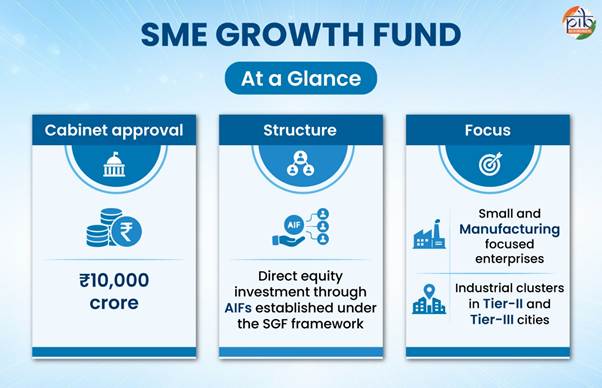
The Union Cabinet, chaired by Prime Minister Narendra Modi, approved the Government of India's commitment of ₹10,000 crore towards establishing the SME Growth Fund (SGF) on 6 October 2026. The new fund is designed to provide growth-oriented equity capital to promising Small and Medium Enterprises and help them develop into larger, competitive Indian enterprises across manufacturing, services, technology, innovation-driven sectors and strategic value chains.
The SME Growth Fund is significant because it addresses a specific financing gap in India's enterprise ecosystem. While many existing equity funds concentrate on start-ups, early-stage companies and micro enterprises, small and medium enterprises that have already demonstrated business viability often need substantial long-term equity capital to expand manufacturing capacity, adopt advanced technology, undertake acquisitions, enter international markets or integrate into global value chains.
The Fund will operate through Alternative Investment Funds established under the SME Growth Fund framework. A major share of its allocation is intended for small and medium manufacturing-focused enterprises, while eligible SMEs located in industrial clusters in Tier-II and Tier-III cities will also be considered. The initiative was originally announced as part of the Union Budget 2026-27's broader strategy of providing equity, liquidity and professional support to the MSME ecosystem.
1. What Did the Union Cabinet Approve?
The Union Cabinet approved a Government of India commitment of ₹10,000 crore for establishing the SME Growth Fund.
The Cabinet decision was announced on 6 October 2026.
The objective is to catalyse growth-oriented capital for Small and Medium Enterprises and help create future champion Indian enterprises.
The Fund is therefore not merely another conventional business-loan programme. Its central feature is equity investment in enterprises with growth potential.
2. What Is the SME Growth Fund?
The SME Growth Fund, abbreviated SGF, is a dedicated growth-capital initiative for Small and Medium Enterprises.
It is intended to provide patient equity capital to high-potential SMEs that have demonstrated business viability and scalability.
The objective is to help promising businesses move from their existing scale to a significantly larger level of operations and competitiveness.
3. How Large Is the Government Commitment?
The Government of India's approved commitment is ₹10,000 crore.
This is one of the most important figures for competitive examinations.
Students should remember: SME Growth Fund — ₹10,000 crore — Cabinet approval — 6 October 2026.
4. Why Was the Fund Created?
According to the Government, existing equity funds largely focus on early-stage enterprises and predominantly cover micro enterprises.
This leaves scope for expanding access to growth equity for Small and Medium Enterprises that have moved beyond the earliest stages of business development but require capital to scale further.
The SME Growth Fund seeks to address this gap.
5. What Is Patient Equity Capital?
Patient capital generally refers to investment capital that is willing to support an enterprise's longer-term growth rather than demanding immediate repayment like a conventional short-duration loan.
In the SGF framework, the emphasis is on equity capital for viable and scalable SMEs.
Such capital can support expansion, technology adoption, acquisitions, strategic investments and international growth.
6. Is the SME Growth Fund a Loan Scheme?
The Fund is designed around direct equity investment rather than conventional debt financing.
This distinction is important.
A loan normally creates an obligation to repay principal with applicable interest, whereas equity investment represents ownership-linked capital invested in an enterprise subject to the structure of the transaction.
The SGF is intended to improve access to growth equity for eligible SMEs.
7. How Will the Fund Operate?
The SME Growth Fund will operate through Alternative Investment Funds established under the SGF framework.
The Government describes it as a direct equity investment structure through such AIFs.
This provides an institutional investment mechanism rather than distributing the entire ₹10,000 crore directly to enterprises as grants.
8. What Is an Alternative Investment Fund?
An Alternative Investment Fund, or AIF, is a privately pooled investment vehicle established in India that collects capital from investors and invests according to a defined investment policy.
AIFs operate within the regulatory framework applicable to such investment funds.
The SME Growth Fund will use AIFs established under its framework to make equity investments.
9. Which Regulator Is Associated with AIFs?
Alternative Investment Funds in India fall within the regulatory framework of the Securities and Exchange Board of India, or SEBI.
For examination purposes, students should associate AIFs with SEBI rather than the Reserve Bank of India.
This distinction can be important in economy and financial-market questions.
10. Which Enterprises Will Be the Main Focus?
The Fund is intended for high-potential Small and Medium Enterprises that demonstrate business viability and scalability.
It aims to support enterprises across manufacturing, services, technology, innovation-driven sectors and strategic value chains.
However, manufacturing will receive particular emphasis.
11. Why Is Manufacturing a Major Focus?
A major share of the SME Growth Fund's allocation is intended for small and medium manufacturing-focused enterprises.
The Fund seeks to help such firms expand manufacturing capacity, adopt advanced technologies, increase productivity and strengthen export competitiveness.
This makes the Fund relevant to India's broader industrialisation and manufacturing strategy.
12. Will Tier-II and Tier-III Cities Be Covered?
Yes. The Fund will also consider SMEs operating in industrial clusters in Tier-II and Tier-III cities.
This geographical focus is important because industrial development in India is not intended to remain concentrated only in major metropolitan centres.
Supporting enterprises in smaller cities can strengthen regional industrial ecosystems, local supply chains and employment opportunities.
13. What Can Growth Capital Be Used For?
The Government's explanatory factsheet identifies several potential uses of long-term growth capital.
These include scaling operations, undertaking acquisitions, fostering innovation, integrating into global value chains, adopting advanced technology, undertaking strategic investments, investing in manufacturing capacity and expanding into international markets.
Thus, the Fund is designed to support enterprise transformation rather than only day-to-day working capital needs.
14. What Is the Connection with Union Budget 2026-27?
The SME Growth Fund was part of the announcements made in Union Budget 2026-27.
The Cabinet approval implements the commitment relating to the ₹10,000 crore Fund announced in Paragraph 28 of the Budget.
The broader Budget strategy for the MSME ecosystem focused on three forms of support: equity, liquidity and professional support.
15. What Are the Latest SME Classification Limits?
Under the criteria effective from April 2025, a small enterprise can have investment in plant and machinery or equipment of up to ₹25 crore and annual turnover of up to ₹100 crore.
A medium enterprise can have investment of up to ₹125 crore and annual turnover of up to ₹500 crore.
These thresholds are useful for examination questions on MSME classification.
16. Why Are Both Investment and Turnover Important?
India's MSME classification uses both investment in plant and machinery or equipment and annual turnover criteria.
This creates a combined framework for determining whether an enterprise falls within the micro, small or medium category.
Therefore, students should not describe the current classification as being based only on number of workers or only on turnover.
17. How Important Are MSMEs to India's GDP?
According to the Economic Survey 2025-26 figures cited by the Government, MSMEs account for 31.1% of India's GDP.
This demonstrates the sector's broad importance to economic activity.
However, the SME Growth Fund specifically targets the growth requirements of Small and Medium Enterprises rather than treating every MSME identically.
18. What Is the MSME Share in Manufacturing Output?
The Government's October 2026 factsheet states that MSMEs account for 35.4% of manufacturing output.
This is one reason why improving the productivity and scale of promising SMEs can have broader implications for India's industrial sector.
Manufacturing is also specifically identified as a major focus of the SME Growth Fund.
19. What Is the MSME Share in India's Exports?
According to the Economic Survey 2025-26 data cited by PIB, MSMEs account for 48.58% of exports.
The high export contribution makes SME competitiveness particularly relevant to India's external sector.
Capital that enables technology adoption, productivity improvement and international expansion can potentially strengthen this contribution.
20. How Many MSMEs Are Formally Registered?
As of 6 October 2026, approximately 9.78 crore MSME registrations had been recorded across the Udyam Registration Portal and Udyam Assist Platform.
The Government also reported approximately 43.28 crore employment opportunities associated with registered enterprises.
These figures illustrate the enormous scale of India's MSME ecosystem.
21. What Is the Udyam Registration Portal?
Udyam Registration is the Government's digital registration framework for MSMEs.
It helps formalise enterprises and provides an official mechanism through which eligible businesses can establish their MSME status for access to relevant schemes and institutional support.
The Udyam ecosystem has significantly expanded the formal registration base of Indian enterprises.
22. What Is the Udyam Assist Platform?
The Udyam Assist Platform, abbreviated UAP, was developed to help bring informal micro enterprises into the formal MSME ecosystem.
Together, Udyam and UAP registrations reached approximately 9.78 crore by 6 October 2026 according to the PIB factsheet.
This formalisation is important for improving access to institutional finance and government support.
23. What Is Women's Participation in Registered MSMEs?
Female-owned enterprises account for 37.6% of total registrations according to the Government's October 2026 factsheet.
This indicates significant participation by women entrepreneurs in India's formalising MSME ecosystem.
It also makes access to finance, markets, technology and professional support relevant to women's entrepreneurship.
24. How Are Registered MSMEs Distributed Across Activities?
The registered MSME base spans trading, services and manufacturing.
As of the Government's October 2026 data, trading accounted for approximately 4.08 crore registrations, services approximately 3.77 crore and manufacturing approximately 1.93 crore.
These numbers show that the MSME ecosystem is not confined to manufacturing alone.
25. Why Is Equity Important for Scaling Businesses?
Debt and equity serve different financing purposes.
A rapidly expanding business may require substantial capital for capacity expansion, acquisitions, technology or entry into new markets. Excessive reliance on debt can increase repayment obligations and financial risk.
Equity capital can provide another source of growth financing, although it can involve sharing ownership and future returns with investors.
26. What Financing Gap Does the SGF Address?
The Government notes that many existing funds focus mainly on early-stage and micro enterprises.
An SME that has already established a viable business may require much larger growth capital to move to the next stage.
The SGF is intended to target this scale-up phase and support enterprises capable of becoming industry leaders.
27. What Is Meant by Future Champion Enterprises?
The expression refers to Indian businesses that can develop sufficient scale, manufacturing capability, productivity, technological strength and competitiveness to become important enterprises in their respective sectors.
The Fund is intended to create a pipeline of such companies rather than merely ensuring survival of existing businesses.
This explains the strong emphasis on scalability and demonstrated business viability.
28. How Can the Fund Support Innovation?
Growth capital can allow enterprises to invest in new technology, research, product development, automation, advanced manufacturing and process improvements.
The SGF specifically includes technology and innovation-driven sectors within its intended scope.
Innovation can improve productivity and help SMEs compete in domestic and international markets.
29. How Can the Fund Support Exports?
SMEs seeking to enter international markets may require capital to expand capacity, meet quality standards, develop products, build distribution networks and integrate into global value chains.
The Government explicitly identifies strengthening export competitiveness and international expansion among the potential outcomes of growth capital.
This is particularly relevant because MSMEs account for a substantial share of India's exports.
30. What Is the Importance of Global Value Chains?
Global value chains distribute different stages of production, sourcing, manufacturing and distribution across multiple countries and firms.
Indian SMEs that develop adequate scale, quality and technological capability can become suppliers or partners in these networks.
The SGF aims to help promising enterprises develop the capabilities needed to participate more effectively in such value chains.
31. How Can Tier-II and Tier-III Industrial Clusters Benefit?
Investment in enterprises located in smaller-city industrial clusters can strengthen local manufacturing networks and supplier ecosystems.
It can also create employment closer to regional population centres and reduce excessive concentration of industrial investment in a few metropolitan areas.
The Fund's inclusion of Tier-II and Tier-III industrial clusters therefore has a regional-development dimension.
32. How Is the SME Growth Fund Different from CGTMSE?
The SME Growth Fund focuses on equity investment in growth-oriented Small and Medium Enterprises.
The Credit Guarantee Fund Trust for Micro and Small Enterprises, or CGTMSE, supports access to credit by providing guarantees for eligible credit facilities to Micro and Small Enterprises.
One is therefore principally an equity-growth initiative, while the other is associated with credit guarantees.
33. How Is It Different from PMEGP?
The Prime Minister's Employment Generation Programme supports the establishment of micro enterprises through a credit-linked subsidy framework.
The SME Growth Fund instead targets high-potential Small and Medium Enterprises requiring equity capital to scale.
Their target stages, financing structures and objectives are therefore different.
34. What Is the Connection with the Self-Reliant India Fund?
The Union Budget 2026-27 also proposed additional support for the Self-Reliant India Fund alongside creation of the SME Growth Fund.
The wider policy strategy recognises that enterprises at different stages require different forms of capital.
The new SGF particularly addresses the growth-equity requirements of Small and Medium Enterprises.
35. What Other MSME Support Programmes Exist?
The Government's October 2026 factsheet identifies several complementary programmes.
CGTMSE provides credit and finance support; PMEGP supports employment generation; PM Vishwakarma provides end-to-end support to traditional artisans and craftspeople; ESDP and ASPIRE support entrepreneurship and skills; RAMP, ZED and technology centres support competitiveness and technology; while MSME SAMBANDH and the SC/ST Hub support public-procurement participation and inclusion.
The SGF therefore operates within a much wider MSME policy ecosystem.
36. What Is the Expected Employment Impact?
The Fund is expected to help high-potential SMEs expand their capacity and scale of operations.
Enterprise expansion can support employment generation directly within recipient firms and indirectly through suppliers, logistics, services and local industrial ecosystems.
The Government has not, in the Cabinet announcement, assigned a fixed guaranteed number of jobs to the ₹10,000 crore Fund, so such a figure should not be invented.
37. Does Cabinet Approval Mean ₹10,000 Crore Will Immediately Be Distributed?
No. Cabinet approval represents the Government's commitment towards establishment of the Fund.
The operational framework involves equity investment through AIFs established under the SGF framework and selection of eligible enterprises.
Therefore, the entire amount should not be described as an immediate grant distributed equally among SMEs.
38. Why Is This Important for UPSC GS Paper III?
The SME Growth Fund connects with industrial policy, MSME financing, manufacturing, employment, exports, regional development, innovation and capital markets.
It can be used as a contemporary example in answers discussing India's challenge of transforming small businesses into globally competitive medium and large enterprises.
A balanced answer should also note that capital alone is insufficient. Enterprises also need technology, skilled workers, management capacity, infrastructure, market access, ease of compliance and strong corporate governance.
39. What Is Important for SSC, Railway and State Exams?
Remember: SME Growth Fund — ₹10,000 crore — approved by Union Cabinet on 6 October 2026 — direct equity investment — Alternative Investment Funds — Small and Medium Enterprises — major focus on manufacturing — Tier-II and Tier-III industrial clusters — Union Budget 2026-27.
Also remember the current classification: Small enterprise — investment up to ₹25 crore and turnover up to ₹100 crore; Medium enterprise — investment up to ₹125 crore and turnover up to ₹500 crore.
40. What Should Students Remember?
The Union Cabinet approved the Government's ₹10,000 crore commitment towards the SME Growth Fund on 6 October 2026.
The Fund will provide growth-oriented equity capital to viable and scalable Small and Medium Enterprises through AIFs established under the SGF framework.
A major share will focus on manufacturing-oriented SMEs, while enterprises in industrial clusters in Tier-II and Tier-III cities will also be considered.
The Fund is intended to support capacity expansion, technology adoption, innovation, acquisitions, strategic investments, international expansion and participation in global value chains.
Quick revision: SGF — ₹10,000 crore — Cabinet approval — 6 October 2026 — direct equity — AIF structure — manufacturing focus — Tier-II and Tier-III clusters — future champion enterprises — Budget 2026-27 — MSMEs contribute 31.1% of GDP, 35.4% of manufacturing output and 48.58% of exports.
क्या हुआ?
प्रधानमंत्री नरेंद्र मोदी की अध्यक्षता में केंद्रीय मंत्रिमंडल ने 6 अक्टूबर 2026 को SME Growth Fund की स्थापना के लिए भारत सरकार की ₹10,000 करोड़ की प्रतिबद्धता को मंजूरी दी। इस नए कोष का उद्देश्य संभावनाशील लघु और मध्यम उद्यमों को विकास-उन्मुख इक्विटी पूंजी उपलब्ध कराना और उन्हें विनिर्माण, सेवाओं, प्रौद्योगिकी, नवाचार आधारित क्षेत्रों तथा रणनीतिक मूल्य शृंखलाओं में बड़ी और प्रतिस्पर्धी भारतीय कंपनियों के रूप में विकसित होने में सहायता देना है।
SME Growth Fund इसलिए विशेष रूप से महत्वपूर्ण है क्योंकि यह भारतीय उद्यम व्यवस्था में वित्तपोषण की एक विशिष्ट कमी को संबोधित करता है। मौजूदा अनेक इक्विटी कोष स्टार्टअप, प्रारंभिक अवस्था की कंपनियों और सूक्ष्म उद्यमों पर केंद्रित रहते हैं। इसके विपरीत, अपनी व्यावसायिक व्यवहार्यता सिद्ध कर चुके लघु और मध्यम उद्यमों को विनिर्माण क्षमता बढ़ाने, उन्नत प्रौद्योगिकी अपनाने, अधिग्रहण करने, अंतरराष्ट्रीय बाजारों में प्रवेश करने या वैश्विक मूल्य शृंखलाओं से जुड़ने के लिए दीर्घकालिक इक्विटी पूंजी की आवश्यकता हो सकती है।
यह कोष SME Growth Fund ढाँचे के अंतर्गत स्थापित वैकल्पिक निवेश कोषों के माध्यम से काम करेगा। इसके आवंटन का बड़ा हिस्सा विनिर्माण पर केंद्रित लघु और मध्यम उद्यमों के लिए निर्धारित किया जाएगा। द्वितीय और तृतीय श्रेणी के शहरों के औद्योगिक समूहों में कार्यरत पात्र उद्यमों पर भी विचार किया जाएगा। यह पहल मूल रूप से केंद्रीय बजट 2026-27 में MSME क्षेत्र को इक्विटी, तरलता और पेशेवर सहायता प्रदान करने की व्यापक रणनीति के हिस्से के रूप में घोषित की गई थी।
1. केंद्रीय मंत्रिमंडल ने क्या मंजूरी दी?
केंद्रीय मंत्रिमंडल ने SME Growth Fund की स्थापना के लिए भारत सरकार की ₹10,000 करोड़ की प्रतिबद्धता को मंजूरी दी।
मंत्रिमंडल का यह निर्णय 6 अक्टूबर 2026 को घोषित किया गया।
इसका उद्देश्य लघु और मध्यम उद्यमों के लिए विकास-उन्मुख पूंजी उपलब्ध कराना और भविष्य की अग्रणी भारतीय कंपनियाँ विकसित करना है।
यह केवल पारंपरिक व्यावसायिक ऋण योजना नहीं है। इसकी मुख्य विशेषता विकास की क्षमता रखने वाले उद्यमों में इक्विटी निवेश है।
2. SME Growth Fund क्या है?
SME Growth Fund को संक्षेप में SGF कहा जाता है। यह लघु और मध्यम उद्यमों के लिए समर्पित विकास-पूंजी पहल है।
इसका उद्देश्य ऐसे उच्च संभावनाशील उद्यमों को दीर्घकालिक इक्विटी पूंजी प्रदान करना है जिन्होंने अपनी व्यावसायिक व्यवहार्यता और विस्तार की क्षमता प्रदर्शित की हो।
इससे संभावनाशील व्यवसायों को वर्तमान स्तर से अधिक बड़े परिचालन और प्रतिस्पर्धात्मक स्तर तक पहुँचने में सहायता मिल सकती है।
3. सरकार की प्रतिबद्धता कितनी है?
भारत सरकार की स्वीकृत प्रतिबद्धता ₹10,000 करोड़ है।
यह प्रतियोगी परीक्षाओं के लिए सबसे महत्वपूर्ण आँकड़ों में से एक है।
याद रखें: SME Growth Fund — ₹10,000 करोड़ — केंद्रीय मंत्रिमंडल की मंजूरी — 6 अक्टूबर 2026।
4. यह कोष क्यों बनाया गया?
सरकार के अनुसार मौजूदा अनेक इक्विटी कोष मुख्यतः प्रारंभिक अवस्था के उद्यमों और सूक्ष्म उद्यमों पर केंद्रित हैं।
इससे ऐसे लघु और मध्यम उद्यमों के लिए विकास इक्विटी की उपलब्धता बढ़ाने की आवश्यकता बनी रहती है जो व्यवसाय के प्रारंभिक चरण से आगे निकल चुके हैं लेकिन अगले स्तर तक पहुँचने के लिए पूंजी चाहते हैं।
SME Growth Fund इसी वित्तीय कमी को संबोधित करने का प्रयास करता है।
5. दीर्घकालिक इक्विटी पूंजी क्या है?
ऐसी पूंजी का उद्देश्य किसी उद्यम के दीर्घकालिक विकास को समर्थन देना होता है और यह पारंपरिक अल्पकालिक ऋण की तरह तत्काल पुनर्भुगतान पर आधारित नहीं होती।
SGF में व्यवहार्य और विस्तार योग्य लघु तथा मध्यम उद्यमों को इक्विटी पूंजी देने पर जोर है।
इसका उपयोग विस्तार, प्रौद्योगिकी अपनाने, अधिग्रहण, रणनीतिक निवेश और अंतरराष्ट्रीय विकास में किया जा सकता है।
6. क्या SME Growth Fund ऋण योजना है?
यह कोष पारंपरिक ऋण के बजाय प्रत्यक्ष इक्विटी निवेश की व्यवस्था पर आधारित है।
यह अंतर महत्वपूर्ण है।
ऋण में सामान्यतः मूलधन और लागू ब्याज चुकाने का दायित्व होता है, जबकि इक्विटी निवेश उद्यम में स्वामित्व से जुड़ी पूंजी का रूप होता है।
SGF का उद्देश्य पात्र उद्यमों के लिए विकास इक्विटी की उपलब्धता बढ़ाना है।
7. यह कोष कैसे काम करेगा?
SME Growth Fund अपने ढाँचे के अंतर्गत स्थापित वैकल्पिक निवेश कोषों के माध्यम से काम करेगा।
सरकार ने इसे ऐसे AIF के माध्यम से प्रत्यक्ष इक्विटी निवेश व्यवस्था के रूप में प्रस्तुत किया है।
इसलिए पूरे ₹10,000 करोड़ को उद्यमों में समान रूप से अनुदान के रूप में वितरित नहीं किया जाएगा।
8. Alternative Investment Fund क्या है?
Alternative Investment Fund अर्थात वैकल्पिक निवेश कोष भारत में स्थापित एक निजी रूप से एकत्रित निवेश व्यवस्था है, जो निवेशकों से पूंजी जुटाकर निर्धारित निवेश नीति के अनुसार उसका निवेश करती है।
ऐसे कोष लागू नियामक व्यवस्था के अंतर्गत कार्य करते हैं।
SME Growth Fund अपने ढाँचे के अंतर्गत स्थापित AIF के माध्यम से इक्विटी निवेश करेगा।
9. AIF से संबंधित नियामक कौन है?
भारत में Alternative Investment Funds भारतीय प्रतिभूति और विनिमय बोर्ड अर्थात SEBI की नियामक व्यवस्था से संबंधित हैं।
परीक्षा के लिए AIF को SEBI से जोड़कर याद रखना चाहिए, न कि भारतीय रिजर्व बैंक से।
अर्थव्यवस्था और वित्तीय बाजार से संबंधित प्रश्नों में यह अंतर महत्वपूर्ण हो सकता है।
10. किन उद्यमों पर मुख्य ध्यान रहेगा?
यह कोष उन उच्च संभावनाशील लघु और मध्यम उद्यमों के लिए बनाया गया है जो व्यावसायिक व्यवहार्यता और विस्तार की क्षमता प्रदर्शित करते हैं।
इसका उद्देश्य विनिर्माण, सेवाओं, प्रौद्योगिकी, नवाचार आधारित क्षेत्रों और रणनीतिक मूल्य शृंखलाओं में उद्यमों को सहायता देना है।
हालांकि विनिर्माण क्षेत्र पर विशेष जोर रहेगा।
11. विनिर्माण पर विशेष ध्यान क्यों है?
SME Growth Fund के आवंटन का बड़ा हिस्सा विनिर्माण पर केंद्रित लघु और मध्यम उद्यमों के लिए होगा।
इसका उद्देश्य कंपनियों को विनिर्माण क्षमता बढ़ाने, उन्नत प्रौद्योगिकी अपनाने, उत्पादकता सुधारने और निर्यात प्रतिस्पर्धात्मकता मजबूत करने में सहायता देना है।
इस कारण यह कोष भारत की व्यापक औद्योगीकरण और विनिर्माण रणनीति से जुड़ता है।
12. क्या द्वितीय और तृतीय श्रेणी के शहर शामिल होंगे?
हाँ। कोष द्वितीय और तृतीय श्रेणी के शहरों के औद्योगिक समूहों में कार्यरत लघु और मध्यम उद्यमों पर भी विचार करेगा।
यह भौगोलिक पहलू महत्वपूर्ण है क्योंकि भारत का औद्योगिक विकास केवल बड़े महानगरों तक सीमित नहीं रहना चाहिए।
छोटे शहरों के उद्यमों को सहायता देने से क्षेत्रीय औद्योगिक व्यवस्था, स्थानीय आपूर्ति शृंखला और रोजगार के अवसर मजबूत हो सकते हैं।
13. विकास पूंजी का उपयोग किन कार्यों में हो सकता है?
सरकार के तथ्य-पत्र में दीर्घकालिक विकास पूंजी के अनेक संभावित उपयोग बताए गए हैं।
इनमें परिचालन का विस्तार, अधिग्रहण, नवाचार को बढ़ावा देना, वैश्विक मूल्य शृंखलाओं में शामिल होना, उन्नत प्रौद्योगिकी अपनाना, रणनीतिक निवेश करना, विनिर्माण क्षमता बढ़ाना और अंतरराष्ट्रीय बाजारों में विस्तार करना शामिल है।
इसलिए यह कोष केवल दैनिक कार्यशील पूंजी की आवश्यकता पूरी करने के लिए नहीं बनाया गया है।
14. केंद्रीय बजट 2026-27 से इसका क्या संबंध है?
SME Growth Fund केंद्रीय बजट 2026-27 में की गई घोषणाओं का हिस्सा था।
मंत्रिमंडल की मंजूरी बजट के अनुच्छेद 28 में घोषित ₹10,000 करोड़ के कोष से संबंधित प्रतिबद्धता को लागू करती है।
MSME व्यवस्था के लिए बजट की व्यापक रणनीति तीन प्रकार की सहायता पर केंद्रित थी: इक्विटी, तरलता और पेशेवर सहायता।
15. लघु और मध्यम उद्यमों की वर्तमान वर्गीकरण सीमा क्या है?
अप्रैल 2025 से लागू मानदंडों के अनुसार लघु उद्यम में संयंत्र और मशीनरी या उपकरण में निवेश ₹25 करोड़ तक और वार्षिक कारोबार ₹100 करोड़ तक हो सकता है।
मध्यम उद्यम में निवेश ₹125 करोड़ तक और वार्षिक कारोबार ₹500 करोड़ तक हो सकता है।
ये सीमाएँ MSME वर्गीकरण से संबंधित परीक्षा प्रश्नों के लिए महत्वपूर्ण हैं।
16. निवेश और कारोबार दोनों क्यों महत्वपूर्ण हैं?
भारत की MSME वर्गीकरण व्यवस्था संयंत्र और मशीनरी या उपकरण में निवेश तथा वार्षिक कारोबार दोनों मानदंडों का उपयोग करती है।
इसी संयुक्त आधार पर यह निर्धारित किया जाता है कि कोई उद्यम सूक्ष्म, लघु या मध्यम श्रेणी में आता है।
इसलिए वर्तमान वर्गीकरण को केवल कर्मचारियों की संख्या या केवल कारोबार पर आधारित नहीं बताना चाहिए।
17. भारत के GDP में MSME का कितना योगदान है?
सरकार द्वारा उद्धृत आर्थिक सर्वेक्षण 2025-26 के अनुसार MSME भारत के GDP में 31.1% योगदान करते हैं।
यह अर्थव्यवस्था में इस क्षेत्र के व्यापक महत्व को दर्शाता है।
हालांकि SME Growth Fund विशेष रूप से लघु और मध्यम उद्यमों की विकास आवश्यकताओं पर केंद्रित है।
18. विनिर्माण उत्पादन में MSME का कितना योगदान है?
सरकार के अक्टूबर 2026 के तथ्य-पत्र के अनुसार MSME का विनिर्माण उत्पादन में योगदान 35.4% है।
यही एक कारण है कि संभावनाशील SME की उत्पादकता और पैमाना बढ़ने का भारत के औद्योगिक क्षेत्र पर व्यापक प्रभाव हो सकता है।
SME Growth Fund में भी विनिर्माण को प्रमुख प्राथमिकता दी गई है।
19. भारत के निर्यात में MSME का कितना योगदान है?
PIB द्वारा उद्धृत आर्थिक सर्वेक्षण 2025-26 के आँकड़ों के अनुसार भारत के निर्यात में MSME का योगदान 48.58% है।
इतना बड़ा निर्यात योगदान SME की प्रतिस्पर्धात्मकता को भारत के बाह्य क्षेत्र के लिए महत्वपूर्ण बनाता है।
प्रौद्योगिकी, उत्पादकता और अंतरराष्ट्रीय विस्तार में सहायता देने वाली पूंजी इस योगदान को मजबूत कर सकती है।
20. कितने MSME पंजीकृत हैं?
6 अक्टूबर 2026 तक Udyam Registration Portal और Udyam Assist Platform पर कुल MSME पंजीकरण लगभग 9.78 करोड़ तक पहुँच गए थे।
सरकार ने पंजीकृत उद्यमों से संबंधित लगभग 43.28 करोड़ रोजगार अवसरों की भी जानकारी दी।
ये आँकड़े भारत के MSME क्षेत्र के विशाल आकार को दर्शाते हैं।
21. Udyam Registration Portal क्या है?
Udyam Registration MSME के लिए सरकार की डिजिटल पंजीकरण व्यवस्था है।
यह उद्यमों को औपचारिक व्यवस्था में लाने और पात्र व्यवसायों को MSME के रूप में अपनी स्थिति स्थापित करने का आधिकारिक माध्यम प्रदान करती है।
इससे संबंधित सरकारी योजनाओं और संस्थागत सहायता तक पहुँच आसान हो सकती है।
22. Udyam Assist Platform क्या है?
Udyam Assist Platform को संक्षेप में UAP कहा जाता है। इसे अनौपचारिक सूक्ष्म उद्यमों को औपचारिक MSME व्यवस्था में लाने में सहायता के लिए विकसित किया गया।
PIB तथ्य-पत्र के अनुसार 6 अक्टूबर 2026 तक Udyam और UAP पर कुल पंजीकरण लगभग 9.78 करोड़ थे।
औपचारिकीकरण संस्थागत वित्त और सरकारी सहायता तक पहुँच सुधारने में महत्वपूर्ण है।
23. पंजीकृत MSME में महिलाओं की भागीदारी कितनी है?
सरकार के अक्टूबर 2026 के तथ्य-पत्र के अनुसार कुल पंजीकरण में महिला स्वामित्व वाले उद्यमों की हिस्सेदारी 37.6% है।
यह भारत की औपचारिक होती MSME व्यवस्था में महिला उद्यमियों की महत्वपूर्ण भागीदारी दर्शाता है।
इससे महिलाओं के लिए वित्त, बाजार, प्रौद्योगिकी और पेशेवर सहायता की उपलब्धता का महत्व भी बढ़ता है।
24. विभिन्न गतिविधियों में MSME पंजीकरण का वितरण क्या है?
पंजीकृत MSME व्यापार, सेवा और विनिर्माण तीनों क्षेत्रों में फैले हैं।
अक्टूबर 2026 के सरकारी आँकड़ों के अनुसार व्यापार क्षेत्र में लगभग 4.08 करोड़, सेवा क्षेत्र में लगभग 3.77 करोड़ और विनिर्माण में लगभग 1.93 करोड़ पंजीकरण थे।
इससे स्पष्ट होता है कि MSME व्यवस्था केवल विनिर्माण क्षेत्र तक सीमित नहीं है।
25. व्यवसाय के विस्तार में इक्विटी क्यों महत्वपूर्ण है?
ऋण और इक्विटी वित्तपोषण के अलग-अलग उद्देश्य होते हैं।
तेजी से बढ़ने वाले व्यवसाय को क्षमता विस्तार, अधिग्रहण, प्रौद्योगिकी या नए बाजारों में प्रवेश के लिए बड़ी पूंजी की आवश्यकता हो सकती है। अत्यधिक ऋण पुनर्भुगतान दायित्व और वित्तीय जोखिम बढ़ा सकता है।
इक्विटी विकास वित्त का दूसरा स्रोत प्रदान कर सकती है, हालांकि इसमें निवेशकों के साथ स्वामित्व और भविष्य के प्रतिफल का हिस्सा साझा करना पड़ सकता है।
26. SGF किस वित्तीय कमी को दूर करता है?
सरकार का कहना है कि मौजूदा अनेक कोष मुख्यतः प्रारंभिक अवस्था और सूक्ष्म उद्यमों पर केंद्रित हैं।
अपना व्यवहार्य व्यवसाय स्थापित कर चुका SME अगले स्तर तक पहुँचने के लिए कहीं अधिक विकास पूंजी चाहता हो सकता है।
SGF इसी विस्तार चरण को लक्षित करता है और उद्योग की अग्रणी कंपनियाँ बनने की क्षमता वाले उद्यमों को सहायता देने का उद्देश्य रखता है।
27. Future Champion Enterprises का क्या अर्थ है?
इससे आशय ऐसी भारतीय कंपनियों से है जो पर्याप्त पैमाना, विनिर्माण क्षमता, उत्पादकता, तकनीकी शक्ति और प्रतिस्पर्धात्मकता विकसित करके अपने क्षेत्र की महत्वपूर्ण कंपनियाँ बन सकें।
इस कोष का उद्देश्य केवल मौजूदा व्यवसायों को जीवित रखना नहीं बल्कि ऐसी कंपनियों की मजबूत शृंखला तैयार करना है।
इसी कारण विस्तार क्षमता और सिद्ध व्यावसायिक व्यवहार्यता पर विशेष जोर दिया गया है।
28. यह कोष नवाचार को कैसे सहायता दे सकता है?
विकास पूंजी कंपनियों को नई प्रौद्योगिकी, अनुसंधान, उत्पाद विकास, स्वचालन, उन्नत विनिर्माण और प्रक्रिया सुधार में निवेश करने की क्षमता दे सकती है।
SGF के दायरे में प्रौद्योगिकी और नवाचार आधारित क्षेत्र विशेष रूप से शामिल हैं।
नवाचार उत्पादकता बढ़ाकर घरेलू और अंतरराष्ट्रीय बाजारों में प्रतिस्पर्धा मजबूत कर सकता है।
29. यह कोष निर्यात को कैसे सहायता दे सकता है?
अंतरराष्ट्रीय बाजार में प्रवेश करने वाले SME को क्षमता विस्तार, गुणवत्ता मानकों, उत्पाद विकास, वितरण नेटवर्क और वैश्विक मूल्य शृंखलाओं से जुड़ने के लिए पूंजी की आवश्यकता हो सकती है।
सरकार ने विकास पूंजी के संभावित परिणामों में निर्यात प्रतिस्पर्धात्मकता मजबूत करने और अंतरराष्ट्रीय विस्तार को स्पष्ट रूप से शामिल किया है।
यह विशेष रूप से महत्वपूर्ण है क्योंकि भारत के निर्यात में MSME की हिस्सेदारी काफी बड़ी है।
30. वैश्विक मूल्य शृंखलाएँ क्यों महत्वपूर्ण हैं?
वैश्विक मूल्य शृंखला में उत्पादन, आपूर्ति, विनिर्माण और वितरण के अलग-अलग चरण विभिन्न देशों और कंपनियों में फैले होते हैं।
पर्याप्त पैमाना, गुणवत्ता और तकनीकी क्षमता विकसित करने वाले भारतीय SME इन नेटवर्कों में आपूर्तिकर्ता या भागीदार बन सकते हैं।
SGF का उद्देश्य संभावनाशील उद्यमों को ऐसी क्षमता विकसित करने में सहायता देना है।
31. द्वितीय और तृतीय श्रेणी के औद्योगिक समूहों को क्या लाभ हो सकता है?
छोटे शहरों के औद्योगिक समूहों में स्थित उद्यमों में निवेश से स्थानीय विनिर्माण नेटवर्क और आपूर्तिकर्ता व्यवस्था मजबूत हो सकती है।
इससे क्षेत्रीय जनसंख्या केंद्रों के निकट रोजगार सृजित हो सकता है और औद्योगिक निवेश के कुछ महानगरों में अत्यधिक केंद्रीकरण को कम करने में सहायता मिल सकती है।
इसलिए Tier-II और Tier-III औद्योगिक समूहों का समावेश क्षेत्रीय विकास से भी जुड़ा है।
32. SME Growth Fund और CGTMSE में क्या अंतर है?
SME Growth Fund विकास-उन्मुख लघु और मध्यम उद्यमों में इक्विटी निवेश पर केंद्रित है।
Credit Guarantee Fund Trust for Micro and Small Enterprises अर्थात CGTMSE पात्र सूक्ष्म और लघु उद्यमों को दी जाने वाली ऋण सुविधाओं पर गारंटी के माध्यम से ऋण तक पहुँच में सहायता करता है।
इसलिए एक मुख्यतः इक्विटी विकास पहल है, जबकि दूसरा ऋण गारंटी से संबंधित है।
33. यह PMEGP से कैसे अलग है?
प्रधानमंत्री रोजगार सृजन कार्यक्रम ऋण-संबद्ध अनुदान व्यवस्था के माध्यम से सूक्ष्म उद्यमों की स्थापना को सहायता देता है।
इसके विपरीत SME Growth Fund ऐसे उच्च संभावनाशील लघु और मध्यम उद्यमों को लक्षित करता है जिन्हें विस्तार के लिए इक्विटी पूंजी चाहिए।
इसलिए दोनों के लक्षित चरण, वित्तीय संरचना और उद्देश्य अलग हैं।
34. Self-Reliant India Fund से इसका क्या संबंध है?
केंद्रीय बजट 2026-27 में SME Growth Fund की स्थापना के साथ Self-Reliant India Fund के लिए अतिरिक्त सहायता का भी प्रस्ताव किया गया था।
व्यापक नीति रणनीति यह स्वीकार करती है कि विकास के अलग-अलग चरणों में उद्यमों को अलग प्रकार की पूंजी की आवश्यकता होती है।
नया SGF विशेष रूप से लघु और मध्यम उद्यमों की विकास इक्विटी आवश्यकता को संबोधित करता है।
35. MSME के लिए अन्य कौन-सी सहायता योजनाएँ हैं?
सरकार के अक्टूबर 2026 तथ्य-पत्र में अनेक पूरक कार्यक्रम बताए गए हैं।
CGTMSE ऋण और वित्तीय सहायता से जुड़ा है; PMEGP रोजगार सृजन को समर्थन देता है; PM Vishwakarma पारंपरिक कारीगरों और शिल्पकारों को समग्र सहायता देता है; ESDP और ASPIRE उद्यमिता और कौशल को समर्थन देते हैं; RAMP, ZED और प्रौद्योगिकी केंद्र प्रतिस्पर्धात्मकता तथा तकनीक से जुड़े हैं; जबकि MSME SAMBANDH और SC/ST Hub सार्वजनिक खरीद तथा समावेशन में सहायता करते हैं।
इसलिए SGF व्यापक MSME नीति व्यवस्था का एक हिस्सा है।
36. रोजगार पर क्या प्रभाव अपेक्षित है?
इस कोष से उच्च संभावनाशील SME को अपनी क्षमता और परिचालन का विस्तार करने में सहायता मिलने की अपेक्षा है।
उद्यमों का विस्तार प्राप्तकर्ता कंपनियों में प्रत्यक्ष तथा आपूर्तिकर्ताओं, परिवहन, सेवाओं और स्थानीय औद्योगिक व्यवस्था में अप्रत्यक्ष रोजगार को समर्थन दे सकता है।
मंत्रिमंडल की घोषणा में ₹10,000 करोड़ के कोष से उत्पन्न होने वाले रोजगार की कोई निश्चित गारंटीकृत संख्या नहीं दी गई है, इसलिए ऐसा आँकड़ा नहीं जोड़ना चाहिए।
37. क्या मंजूरी मिलते ही ₹10,000 करोड़ तुरंत बाँट दिए जाएंगे?
नहीं। मंत्रिमंडल की मंजूरी कोष की स्थापना के लिए सरकार की प्रतिबद्धता को दर्शाती है।
परिचालन ढाँचे में SGF के अंतर्गत स्थापित AIF के माध्यम से इक्विटी निवेश और पात्र उद्यमों का चयन शामिल होगा।
इसलिए पूरे ₹10,000 करोड़ को तत्काल और समान रूप से SME को दिए जाने वाले अनुदान के रूप में नहीं समझना चाहिए।
38. UPSC GS Paper III के लिए यह क्यों महत्वपूर्ण है?
SME Growth Fund औद्योगिक नीति, MSME वित्तपोषण, विनिर्माण, रोजगार, निर्यात, क्षेत्रीय विकास, नवाचार और पूंजी बाजार से जुड़ता है।
भारत में छोटे व्यवसायों को वैश्विक स्तर पर प्रतिस्पर्धी मध्यम और बड़ी कंपनियों में बदलने की चुनौती पर उत्तर लिखते समय इसे समसामयिक उदाहरण के रूप में उपयोग किया जा सकता है।
संतुलित उत्तर में यह भी लिखना चाहिए कि केवल पूंजी पर्याप्त नहीं है। उद्यमों को प्रौद्योगिकी, कुशल श्रमिक, प्रबंधन क्षमता, अवसंरचना, बाजार पहुँच, सरल अनुपालन और मजबूत कॉरपोरेट प्रशासन की भी आवश्यकता होती है।
39. SSC, Railway और State Exams के लिए क्या महत्वपूर्ण है?
याद रखें: SME Growth Fund — ₹10,000 करोड़ — 6 अक्टूबर 2026 को केंद्रीय मंत्रिमंडल की मंजूरी — प्रत्यक्ष इक्विटी निवेश — Alternative Investment Funds — लघु और मध्यम उद्यम — विनिर्माण पर विशेष जोर — Tier-II और Tier-III औद्योगिक समूह — केंद्रीय बजट 2026-27।
वर्तमान वर्गीकरण भी याद रखें: लघु उद्यम — निवेश ₹25 करोड़ तक और कारोबार ₹100 करोड़ तक; मध्यम उद्यम — निवेश ₹125 करोड़ तक और कारोबार ₹500 करोड़ तक।
40. विद्यार्थियों को क्या याद रखना चाहिए?
केंद्रीय मंत्रिमंडल ने 6 अक्टूबर 2026 को SME Growth Fund के लिए भारत सरकार की ₹10,000 करोड़ की प्रतिबद्धता को मंजूरी दी।
यह कोष SGF ढाँचे के अंतर्गत स्थापित AIF के माध्यम से व्यवहार्य और विस्तार योग्य लघु तथा मध्यम उद्यमों को विकास-उन्मुख इक्विटी पूंजी उपलब्ध कराएगा।
इसके आवंटन का बड़ा हिस्सा विनिर्माण केंद्रित SME के लिए होगा और Tier-II तथा Tier-III शहरों के औद्योगिक समूहों में स्थित उद्यमों पर भी विचार किया जाएगा।
यह क्षमता विस्तार, प्रौद्योगिकी अपनाने, नवाचार, अधिग्रहण, रणनीतिक निवेश, अंतरराष्ट्रीय विस्तार और वैश्विक मूल्य शृंखलाओं में भागीदारी को समर्थन देने के लिए बनाया गया है।
त्वरित पुनरावृत्ति: SGF — ₹10,000 करोड़ — मंत्रिमंडल की मंजूरी — 6 अक्टूबर 2026 — प्रत्यक्ष इक्विटी — AIF व्यवस्था — विनिर्माण पर जोर — Tier-II और Tier-III समूह — भविष्य की अग्रणी कंपनियाँ — बजट 2026-27 — GDP में MSME 31.1%, विनिर्माण उत्पादन में 35.4% और निर्यात में 48.58% योगदान।
Key Facts
• The Union Cabinet approved the SME Growth Fund on 6 October 2026.
• The Government of India commitment towards the Fund is ₹10,000 crore.
• SGF stands for SME Growth Fund.
• The Fund targets Small and Medium Enterprises.
• The SGF is designed to provide growth-oriented equity capital.
• It will focus on enterprises demonstrating business viability and scalability.
• The Fund will operate through Alternative Investment Funds established under the SGF framework.
• The structure involves direct equity investment rather than a conventional loan-only model.
• A major share of allocations will focus on manufacturing-oriented SMEs.
• SMEs in industrial clusters in Tier-II and Tier-III cities will also be considered.
• The initiative was announced as part of Union Budget 2026-27.
• The Budget's broader MSME strategy includes equity, liquidity and professional support.
• The Fund can support manufacturing-capacity expansion.
• It can support adoption of advanced technology.
• It can support productivity improvements.
• It can help strengthen export competitiveness.
• Growth capital can support acquisitions.
• It can support strategic investments.
• It can help enterprises integrate into global value chains.
• It can support expansion into international markets.
• Under criteria effective from April 2025, a small enterprise has investment up to ₹25 crore and turnover up to ₹100 crore.
• A medium enterprise has investment up to ₹125 crore and turnover up to ₹500 crore.
• MSMEs contribute 31.1% of India's GDP according to Economic Survey 2025-26 figures cited by PIB.
• MSMEs account for 35.4% of manufacturing output.
• MSMEs account for 48.58% of exports.
• Udyam and Udyam Assist registrations reached approximately 9.78 crore as of 6 October 2026.
• Registered MSMEs reported approximately 43.28 crore employment opportunities.
• Female-owned enterprises account for 37.6% of total registrations.
• Trading accounted for approximately 4.08 crore registrations.
• Services accounted for approximately 3.77 crore registrations.
• Manufacturing accounted for approximately 1.93 crore registrations.
• The SGF seeks to address a growth-equity gap for Small and Medium Enterprises.
• Existing equity funds largely focus on early-stage and micro enterprises according to the Government.
• The Fund aims to develop a pipeline of future champion Indian enterprises.
• The Cabinet announcement does not specify a guaranteed number of jobs to be created by the Fund.
मुख्य तथ्य
• केंद्रीय मंत्रिमंडल ने 6 अक्टूबर 2026 को SME Growth Fund को मंजूरी दी।
• इस कोष के लिए भारत सरकार की प्रतिबद्धता ₹10,000 करोड़ है।
• SGF का अर्थ SME Growth Fund है।
• यह कोष लघु और मध्यम उद्यमों को लक्षित करता है।
• SGF विकास-उन्मुख इक्विटी पूंजी उपलब्ध कराने के लिए बनाया गया है।
• इसमें व्यावसायिक व्यवहार्यता और विस्तार क्षमता प्रदर्शित करने वाले उद्यमों पर ध्यान रहेगा।
• यह SGF ढाँचे के अंतर्गत स्थापित Alternative Investment Funds के माध्यम से कार्य करेगा।
• इसकी संरचना पारंपरिक ऋण आधारित व्यवस्था के बजाय प्रत्यक्ष इक्विटी निवेश पर केंद्रित है।
• आवंटन का बड़ा हिस्सा विनिर्माण केंद्रित SME के लिए होगा।
• Tier-II और Tier-III शहरों के औद्योगिक समूहों के SME पर भी विचार किया जाएगा।
• इस पहल की घोषणा केंद्रीय बजट 2026-27 में की गई थी।
• बजट की व्यापक MSME रणनीति में इक्विटी, तरलता और पेशेवर सहायता शामिल है।
• यह कोष विनिर्माण क्षमता विस्तार में सहायता कर सकता है।
• यह उन्नत प्रौद्योगिकी अपनाने में सहायता कर सकता है।
• यह उत्पादकता सुधार को समर्थन दे सकता है।
• यह निर्यात प्रतिस्पर्धात्मकता मजबूत करने में सहायता कर सकता है।
• विकास पूंजी अधिग्रहण में सहायता कर सकती है।
• यह रणनीतिक निवेश को समर्थन दे सकती है।
• यह उद्यमों को वैश्विक मूल्य शृंखलाओं से जुड़ने में सहायता कर सकती है।
• यह अंतरराष्ट्रीय बाजारों में विस्तार में सहायता कर सकती है।
• अप्रैल 2025 से लागू मानदंडों में लघु उद्यम के लिए निवेश सीमा ₹25 करोड़ और कारोबार सीमा ₹100 करोड़ है।
• मध्यम उद्यम के लिए निवेश सीमा ₹125 करोड़ और कारोबार सीमा ₹500 करोड़ है।
• PIB द्वारा उद्धृत आर्थिक सर्वेक्षण 2025-26 के अनुसार MSME भारत के GDP में 31.1% योगदान करते हैं।
• विनिर्माण उत्पादन में MSME का योगदान 35.4% है।
• निर्यात में MSME का योगदान 48.58% है।
• 6 अक्टूबर 2026 तक Udyam और Udyam Assist पर लगभग 9.78 करोड़ पंजीकरण हो चुके थे।
• पंजीकृत MSME ने लगभग 43.28 करोड़ रोजगार अवसरों की जानकारी दी।
• कुल पंजीकरण में महिला स्वामित्व वाले उद्यमों की हिस्सेदारी 37.6% है।
• व्यापार क्षेत्र में लगभग 4.08 करोड़ पंजीकरण थे।
• सेवा क्षेत्र में लगभग 3.77 करोड़ पंजीकरण थे।
• विनिर्माण क्षेत्र में लगभग 1.93 करोड़ पंजीकरण थे।
• SGF का उद्देश्य लघु और मध्यम उद्यमों के लिए विकास इक्विटी की कमी को संबोधित करना है।
• सरकार के अनुसार मौजूदा अनेक इक्विटी कोष प्रारंभिक अवस्था और सूक्ष्म उद्यमों पर अधिक केंद्रित हैं।
• इस कोष का उद्देश्य भविष्य की अग्रणी भारतीय कंपनियों की मजबूत शृंखला विकसित करना है।
• मंत्रिमंडल की घोषणा में इस कोष से उत्पन्न होने वाले रोजगार की कोई निश्चित गारंटीकृत संख्या नहीं दी गई है।
Background
India's MSME ecosystem is a major contributor to production, employment and exports, but businesses at different stages require different forms of finance. Micro and early-stage enterprises may primarily need initial credit or seed capital, while established Small and Medium Enterprises can require much larger pools of long-term growth equity to expand manufacturing, adopt technology, undertake acquisitions and enter global markets. The SME Growth Fund was announced in Union Budget 2026-27 as part of a broader approach combining equity, liquidity and professional support. The Union Cabinet's approval of a ₹10,000 crore Government commitment on 6 October 2026 moves this proposal towards implementation through an AIF-based direct-equity structure.
पृष्ठभूमि
भारत का MSME क्षेत्र उत्पादन, रोजगार और निर्यात में महत्वपूर्ण योगदान देता है, लेकिन विकास के अलग-अलग चरणों में व्यवसायों को अलग प्रकार के वित्त की आवश्यकता होती है। सूक्ष्म और प्रारंभिक अवस्था के उद्यमों को शुरुआती ऋण या प्रारंभिक पूंजी की आवश्यकता हो सकती है, जबकि स्थापित लघु और मध्यम उद्यमों को विनिर्माण विस्तार, प्रौद्योगिकी अपनाने, अधिग्रहण और वैश्विक बाजार में प्रवेश के लिए कहीं अधिक दीर्घकालिक विकास इक्विटी की आवश्यकता हो सकती है। SME Growth Fund की घोषणा केंद्रीय बजट 2026-27 में इक्विटी, तरलता और पेशेवर सहायता को मिलाकर बनाई गई व्यापक रणनीति के हिस्से के रूप में हुई थी। 6 अक्टूबर 2026 को ₹10,000 करोड़ की सरकारी प्रतिबद्धता को केंद्रीय मंत्रिमंडल की मंजूरी इस प्रस्ताव को AIF आधारित प्रत्यक्ष इक्विटी व्यवस्था के माध्यम से कार्यान्वयन की दिशा में आगे बढ़ाती है।
Why It Matters
The SME Growth Fund is important because India's challenge is not only to create new enterprises but also to help viable smaller firms achieve greater scale. A company that has already established a successful business model may require equity rather than additional debt to finance a major expansion. By focusing on scalable SMEs, manufacturing, technology adoption, industrial clusters and international competitiveness, the Fund attempts to fill this growth-capital gap. Its broader significance lies in the possibility of developing Indian enterprises capable of becoming larger sectoral champions, strengthening domestic manufacturing, generating employment and participating more deeply in global value chains.
यह क्यों महत्वपूर्ण है?
SME Growth Fund इसलिए महत्वपूर्ण है क्योंकि भारत के सामने चुनौती केवल नए उद्यम स्थापित करने की नहीं बल्कि व्यवहार्य छोटे व्यवसायों को बड़े पैमाने तक पहुँचाने की भी है। सफल व्यावसायिक मॉडल स्थापित कर चुकी कंपनी को बड़े विस्तार के लिए अतिरिक्त ऋण के बजाय इक्विटी की आवश्यकता हो सकती है। विस्तार योग्य SME, विनिर्माण, प्रौद्योगिकी अपनाने, औद्योगिक समूहों और अंतरराष्ट्रीय प्रतिस्पर्धात्मकता पर ध्यान देकर यह कोष विकास पूंजी की इसी कमी को दूर करने का प्रयास करता है। इसका व्यापक महत्व ऐसी भारतीय कंपनियाँ विकसित करने की संभावना में है जो अपने क्षेत्रों की बड़ी अग्रणी कंपनियाँ बन सकें, घरेलू विनिर्माण मजबूत करें, रोजगार सृजित करें और वैश्विक मूल्य शृंखलाओं में भारत की भागीदारी बढ़ाएँ।
Exam Connection
For exams remember: Union Cabinet approved a ₹10,000 crore Government commitment for the SME Growth Fund on 6 October 2026. SGF will provide direct growth equity through AIFs to viable and scalable Small and Medium Enterprises. Manufacturing-focused SMEs will receive major emphasis, while industrial clusters in Tier-II and Tier-III cities are also included in the strategic focus. The initiative originated in Union Budget 2026-27. Under classification criteria effective from April 2025, Small Enterprise: investment up to ₹25 crore and turnover up to ₹100 crore; Medium Enterprise: investment up to ₹125 crore and turnover up to ₹500 crore. MSME contribution cited by PIB: 31.1% of GDP, 35.4% of manufacturing output and 48.58% of exports.
परीक्षा से संबंध
परीक्षा के लिए याद रखें: केंद्रीय मंत्रिमंडल ने 6 अक्टूबर 2026 को SME Growth Fund के लिए ₹10,000 करोड़ की सरकारी प्रतिबद्धता को मंजूरी दी। SGF व्यवहार्य और विस्तार योग्य लघु तथा मध्यम उद्यमों को AIF के माध्यम से प्रत्यक्ष विकास इक्विटी उपलब्ध कराएगा। विनिर्माण केंद्रित SME पर विशेष जोर रहेगा और Tier-II तथा Tier-III शहरों के औद्योगिक समूह भी रणनीतिक प्राथमिकता में शामिल हैं। यह पहल केंद्रीय बजट 2026-27 में घोषित की गई थी। अप्रैल 2025 से लागू वर्गीकरण: लघु उद्यम — निवेश ₹25 करोड़ तक, कारोबार ₹100 करोड़ तक; मध्यम उद्यम — निवेश ₹125 करोड़ तक, कारोबार ₹500 करोड़ तक। PIB द्वारा उद्धृत MSME योगदान: GDP में 31.1%, विनिर्माण उत्पादन में 35.4% और निर्यात में 48.58%।
 SSC CGL 2026 Ultimate Chapterwise
 SSC CHSL 2026 Ultimate Chapterwise